

Starting an online business can feel overwhelming, especially when you’re bombarded with conflicting advice and don’t know where to begin. If you’re an aspiring entrepreneur, small business owner, or side hustler wondering about the basics of launching your first digital venture, you’re not alone—and you’re in the right place.
The truth is, almost every successful online entrepreneur started with the same questions and concerns you have right now. There are no “dumb” questions when it comes to building your financial future, and the uncertainty you’re feeling is completely normal. What matters most is taking that first step armed with the right information.
This comprehensive FAQ guide tackles the most common FAQs about starting an online business, demystifies the process, breaks down barriers to action, and gives you the confidence to move forward with your entrepreneurial dreams.
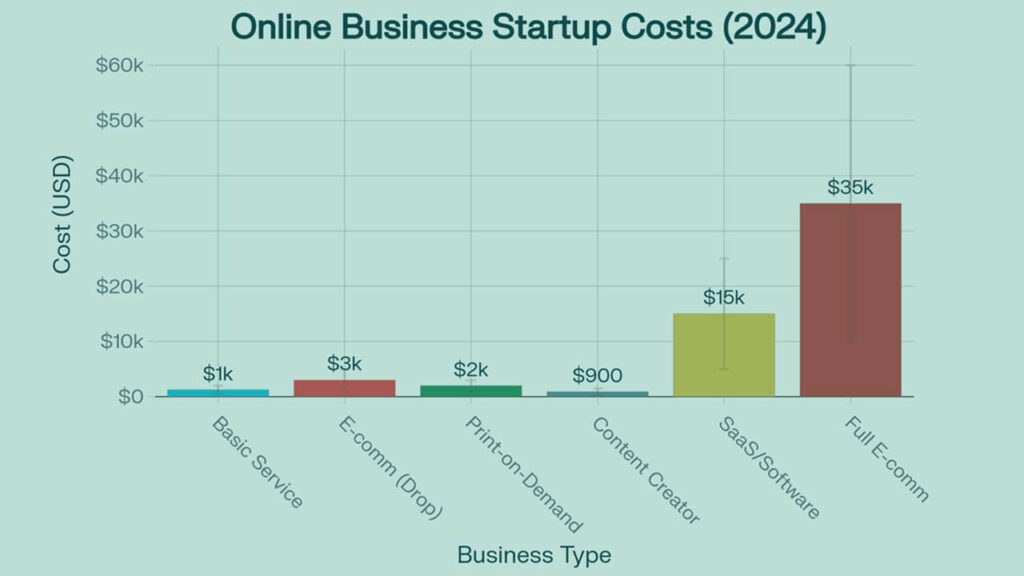
Comprehensive breakdown of startup costs for different online business models in 2024
Getting Started: Basic FAQs About Starting an Online Business

Do I need a lot of money to start an online business?
No, you don’t need substantial capital to start most online businesses. While traditional brick-and-mortar businesses often require significant upfront investment, online ventures can be launched with minimal funds.
Low-cost online business options include:
- Service-based businesses (consulting, freelancing): $300-2,000
- Content creation (blogging, YouTube): $300-1,500
- Dropshipping stores: $1,000-5,000
- Print-on-demand products: $1,000-3,000
According to recent data, the average cost to start an online business in 2024 ranges from $1,000 to $60,000, but many successful entrepreneurs began with less than $500. The key is starting small and reinvesting profits as you grow.
Essential startup costs typically include:
- Domain name and web hosting: $100-500/year
- Basic website or e-commerce platform: $0-300/month
- Initial marketing budget: $200-1,000
- Business registration and licenses: $50-500
Can I start part-time while working/studying full-time?
Absolutely—and it’s often the smartest approach. Most successful online entrepreneurs started as side hustles while maintaining steady income from their primary job or studies.
Benefits of starting part-time:
- Financial security while building your business
- Lower pressure to generate immediate income
- Time to test and refine your business model
- Gradual skill development without overwhelming yourself
Research shows that entrepreneurs who start part-time are often more successful because they can focus on building sustainable systems rather than scrambling for quick profits. Many business owners report running successful online ventures with just 10-20 hours per week of dedicated work.
Time management strategies:
- Dedicate specific hours daily (early mornings or evenings work well)
- Use weekends for larger projects and planning
- Automate repetitive tasks as soon as possible
- Focus on high-impact activities that drive revenue
What if I’m not tech-savvy—can I still succeed?
Yes, lack of technical skills shouldn’t stop you from starting an online business. Today’s tools and platforms are designed for non-technical users, and you can learn as you go.
Beginner-friendly solutions:
- Website builders like Squarespace, Wix, or Shopify require no coding
- Drag-and-drop interfaces make design simple
- Pre-built templates handle the technical foundation
- Customer support and tutorials guide you through setup
The most important skills for online business success are actually non-technical: understanding your customers, creating value, marketing effectively, and managing finances. Technical skills can be learned over time or outsourced to specialists.
Learning resources:
- YouTube tutorials for any platform or tool
- Platform-specific help centers and documentation
- Online courses on sites like Udemy or Coursera
- Community forums where beginners help each other
Legal & Finance Essentials
What are the legal steps for launching an online business?
Legal requirements vary by location and business type, but common steps include:
Business Structure Setup:
- Choose your business entity (sole proprietorship, LLC, corporation)
- Register your business name
- Obtain necessary licenses and permits
- Get an Employer Identification Number (EIN) for tax purposes
For most online businesses in major markets:
- Business registration: Required in most jurisdictions ($50-500)
- Tax registration: Essential for collecting and paying taxes
- Professional licenses: Only needed for specific industries (healthcare, legal, financial services)
- Digital compliance: Privacy policies, terms of service, data protection measures
International considerations:
- GST/VAT registration may be required based on sales volume
- Cross-border tax obligations if selling internationally
- Intellectual property protection for your brand and content
It’s advisable to consult with a business attorney or accountant familiar with online commerce in your region to ensure full compliance.
How do I register my business and do I need a license?
Business registration requirements depend on your chosen structure and location:
Basic Registration Steps:
- Choose business structure (LLC recommended for most online businesses)
- Select and reserve business name
- File incorporation documents with your state/country
- Obtain EIN/Tax ID number
- Open business bank account
- Register for applicable taxes (sales tax, income tax)
Licensing requirements:
- General business license: Required in some localities
- Industry-specific licenses: Needed for regulated sectors (food, healthcare, finance)
- Professional certifications: Required for consulting in licensed fields
- Import/export permits: Necessary if shipping internationally
Most pure online service businesses (consulting, digital products, content creation) require minimal licensing beyond basic business registration.
What taxes do I need to pay as an online entrepreneur?
Online businesses typically face several tax obligations:
Federal/National Taxes:
- Income tax on business profits (varies by structure and income level)
- Self-employment tax (approximately 15.3% in the US) for Social Security and Medicare
- Estimated quarterly payments if you expect to owe more than $1,000
State/Regional Taxes:
- Income tax (varies by location, some areas have no state income tax)
- Sales tax collection and remittance (required if you have nexus in tax states)
- Business personal property tax in some jurisdictions
International Tax Considerations:
- GST/VAT obligations when selling to customers in different countries
- Digital services taxes in some regions for online services
- Income reporting requirements for foreign-earned revenue
Tax planning recommendations:
- Set aside 30-40% of profits for taxes
- Make quarterly estimated payments to avoid penalties
- Keep detailed records of all business income and expenses
- Consider working with a tax professional familiar with online businesses
Tools & Website Setup

Which website platform should I use to get started?
The best platform depends on your business type and technical comfort level:
For E-commerce Stores:
- Shopify ($29/month): Best overall for product sales, extensive features
- WooCommerce (Free + hosting): Most flexible, requires more technical knowledge
- BigCommerce ($29/month): Strong built-in features, good for scaling
For Service Businesses:
- Squarespace ($16/month): Beautiful templates, easy drag-and-drop editor
- Wix ($17/month): Most beginner-friendly, extensive customization options
- WordPress.com ($4/month): Powerful blogging and content features
For Simple Landing Pages:
- Carrd ($19/year): Perfect for single-page sites
- Leadpages ($37/month): Optimized for lead generation
- Unbounce ($80/month): Advanced conversion optimization
Key selection criteria:
- Ease of use vs. customization needs
- Monthly costs vs. transaction fees
- Built-in features vs. third-party integrations
- Scalability for future growth
Most experts recommend starting with a user-friendly platform like Squarespace or Shopify, then migrating to more powerful solutions as your business grows.
What are the essential tools every beginner needs?
Core Business Tools (Most Can Start Free):
Website & Hosting:
- Domain name ($10-20/year)
- Website builder or hosting ($5-50/month)
- SSL certificate (often included)
Communication & Marketing:
- Email marketing platform (MailChimp, ConvertKit: Free-$29/month)
- Social media management (Buffer, Hootsuite: Free-$15/month)
- Video conferencing (Zoom, Google Meet: Free-$15/month)
Business Operations:
- Project management (Trello, Asana: Free-$10/month)
- Cloud storage (Google Drive, Dropbox: Free-$10/month)
- Accounting software (QuickBooks, Wave: Free-$25/month)
Design & Content:
- Graphic design (Canva: Free-$15/month)
- Photo editing (GIMP free, Adobe: $20/month)
- Content creation tools (Grammarly: Free-$12/month)
Analytics & Optimization:
- Google Analytics (Free)
- Google Search Console (Free)
- Social media analytics (built into platforms)
Total monthly cost for essential tools: $50-200, with many free options available to start. The key is beginning with free or low-cost solutions and upgrading as your revenue grows.
Free vs. paid website builders—what’s the difference?
Free Website Builder Limitations:
- Branded domain (yoursite.platformname.com instead of yoursite.com)
- Platform ads displayed on your website
- Limited storage and bandwidth
- Restricted customization options
- No e-commerce capabilities or limited transaction features
- Basic customer support only
Paid Plan Benefits:
- Custom domain name for professional credibility
- Ad-free experience for visitors
- Unlimited storage and bandwidth
- Advanced customization options and premium templates
- E-commerce features including payment processing
- Priority customer support and phone/chat assistance
- SEO tools and analytics integration
- Professional email addresses
Cost-benefit analysis:
While free plans seem attractive, they often hurt your professional credibility and limit growth potential. Most successful online businesses invest in paid plans within the first few months, typically $10-30/month for basic professional features.
Recommendation: Start with a free plan to test your concept, but upgrade to paid hosting within 30-60 days if you’re serious about building a sustainable business.
Marketing & Money

How do I get my first customer or client?
Proven customer acquisition strategies for beginners:
Immediate Tactics (0-30 days):
- Leverage existing network: Tell friends, family, and colleagues about your business
- Social media announcement: Share your launch across all platforms
- Local community engagement: Join relevant Facebook groups, forums, or local business networks
- Content marketing: Start blogging or creating videos in your niche
Short-term Growth (1-6 months):
- Search engine optimization: Optimize your website for relevant keywords
- Social proof: Gather testimonials and reviews from early customers
- Partnerships: Collaborate with complementary businesses
- Paid advertising: Start small with Google Ads or Facebook Ads ($100-500 budget)
Sustainable Systems (6+ months):
- Email marketing: Build a list of interested prospects
- Referral programs: Incentivize existing customers to refer others
- Content authority: Establish yourself as an expert through consistent valuable content
- Networking: Attend industry events and build professional relationships
Success metrics to track:
- Website visitors and conversion rates
- Social media engagement and followers
- Email open rates and click-throughs
- Customer acquisition cost vs. lifetime value
How do I market my online business on a small (or zero) budget?
Free Marketing Strategies That Work:
Content Marketing (Time Investment: 5-10 hours/week):
- Blogging: Write helpful articles targeting your ideal customers
- YouTube videos: Create tutorials, tips, or behind-the-scenes content
- Podcast guesting: Appear on shows your target audience listens to
- Social media: Share valuable content consistently across platforms
Search Engine Optimization:
- Keyword research: Use free tools like Google Keyword Planner
- On-page optimization: Optimize titles, descriptions, and content for search
- Local SEO: Claim and optimize Google My Business listing
- Link building: Guest post on relevant websites and build relationships
Community Engagement:
- Social media groups: Participate helpfully in Facebook groups and LinkedIn communities
- Forums: Answer questions on Reddit, Quora, or industry-specific forums
- Local networking: Attend Chamber of Commerce or entrepreneur meetups
- Online communities: Join Slack groups or Discord servers in your niche
Partnership Marketing:
- Cross-promotion: Partner with complementary businesses
- Guest posting: Write for other websites in exchange for backlinks
- Collaboration: Team up with other creators for joint projects
- Affiliate partnerships: Set up referral systems with other businesses
Budget allocation for beginners:
- 15-20% of revenue for marketing (higher for startups building awareness)
- Start with $100-500/month for paid advertising once you have some organic traction
- Focus 80% effort on free strategies initially, gradually increasing paid promotion
How long does it take to make money online?
Realistic Timeline Expectations:
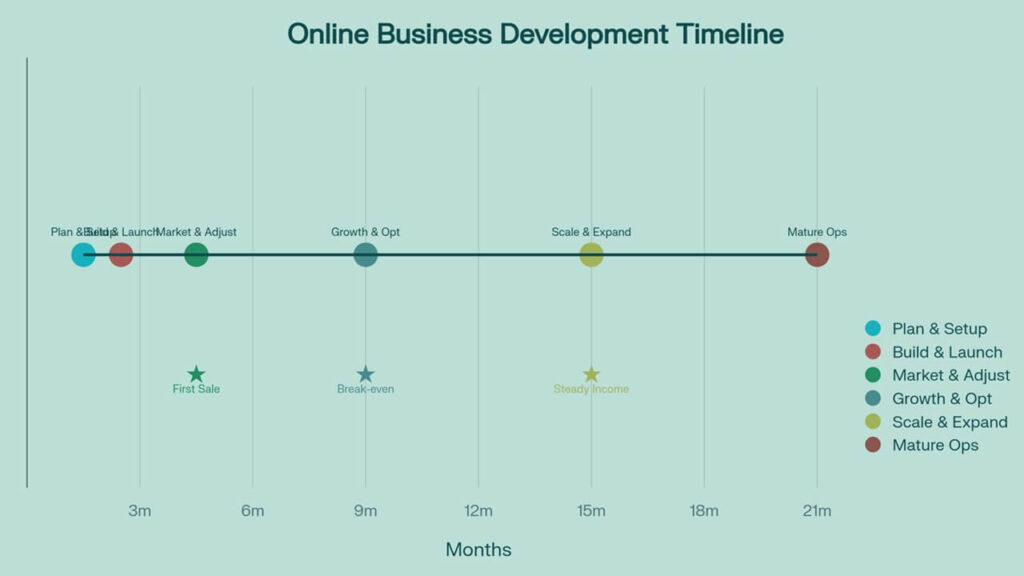
Timeline showing the typical stages and milestones when starting an online business from idea to sustainable operations
Months 1-3: Foundation Phase
- Focus: Building systems, creating content, establishing presence
- Typical earnings: $0-500/month
- Key milestone: First sale or client
Months 3-6: Early Growth Phase
- Focus: Customer acquisition, refining offering, building reputation
- Typical earnings: $500-2,000/month
- Key milestone: Consistent weekly sales
Months 6-12: Scaling Phase
- Focus: Optimizing marketing, expanding services, building team
- Typical earnings: $2,000-10,000/month
- Key milestone: Replace part-time income
Months 12-18: Expansion Phase
- Focus: New products/services, advanced marketing, automation
- Typical earnings: $10,000+/month
- Key milestone: Full-time income replacement
Factors affecting timeline:
- Industry and business model (service businesses typically generate revenue faster)
- Time investment (more hours generally equals faster results)
- Previous experience and existing network
- Market demand for your offering
- Marketing effectiveness and customer acquisition efficiency
Reality check: According to industry data, 90% of online businesses fail, but those that survive typically see meaningful revenue within 6-12 months of consistent effort. Success requires patience, persistence, and continuous learning.
Common Mistakes & Mindset

What are the biggest risks or mistakes for beginners?
Critical Mistakes That Kill Online Businesses:
Planning & Strategy Errors:
- Skipping market research: Building products/services nobody wants
- Lack of business plan: Operating without clear goals or financial projections
- Trying to serve everyone: Not defining a specific target audience
- Perfectionism paralysis: Waiting for everything to be perfect before launching
Financial Management Mistakes:
- Underestimating costs: Not budgeting for ongoing expenses and taxes
- No emergency fund: Having no cushion for slow periods or unexpected costs
- Mixing personal and business finances: Making tax time and bookkeeping nightmarish
- Ignoring cash flow: Not tracking when money comes in vs. goes out
Marketing & Customer Acquisition Blunders:
- Building it and they will come mentality: Assuming customers will find you automatically
- Neglecting social proof: Not collecting testimonials and reviews early
- Inconsistent messaging: Confusing potential customers about what you offer
- Ignoring customer feedback: Not adapting based on what customers actually want
Operational Pitfalls:
- Poor time management: Not prioritizing revenue-generating activities
- Technology overwhelm: Trying to use every new tool instead of mastering basics
- Scaling too fast: Growing before systems can handle increased demand
- Neglecting legal requirements: Ignoring taxes, licenses, or compliance issues
How to avoid these mistakes:
- Start with thorough market research and validate demand before building
- Create detailed financial projections and track them monthly
- Focus on one customer segment and one marketing channel initially
- Launch quickly with a minimum viable product, then improve based on feedback
What common scams or frauds should I watch out for?
Red Flags in Online Business Opportunities:
Get-Rich-Quick Schemes:
- “Make $10,000 in 30 days guaranteed” claims
- “No experience necessary“ promises for high-income opportunities
- Pressure to “act now” or limited-time offers that seem urgent
- Upfront fees for “guaranteed” income opportunities
Fake Coaching and Courses:
- Unrealistic income screenshots that can be easily faked
- “Secret system” claims without showing actual methods
- High-pressure sales tactics and artificial scarcity
- No real testimonials or social proof from verified customers
Service Provider Scams:
- Extremely low prices for professional services (often from overseas with poor quality)
- No portfolio or examples of previous work
- Payment required upfront for large projects
- Vague contracts or no contracts at all
Website and Technical Scams:
- “We’ll build your website for $99” but charge hundreds in monthly fees
- SEO services promising “#1 Google ranking guaranteed”
- Email list rental or purchase (these lists perform poorly and may be illegal)
- Fake reviews services that violate platform terms of service
Protection strategies:
- Research any opportunity thoroughly before investing money or time
- Verify testimonials and success stories independently
- Never pay large amounts upfront for unproven services
- Trust your instincts—if something seems too good to be true, it probably is
- Join legitimate entrepreneur communities for advice and scam warnings
How much time do I need to invest per week to see progress?
Time Investment Guidelines by Business Stage:
Startup Phase (Months 1-6):
- Minimum viable commitment: 10-15 hours/week
- Recommended for faster progress: 20-25 hours/week
- Time allocation: 40% building/creating, 30% marketing, 20% learning, 10% administration
Growth Phase (Months 6-18):
- Maintenance level: 15-20 hours/week
- Aggressive growth: 30-40 hours/week
- Time allocation: 30% marketing, 25% customer service, 25% product development, 20% operations
Established Phase (18+ months):
- Efficient operations: 10-20 hours/week
- Expansion mode: 25-35 hours/week
- Time allocation: 40% strategy/planning, 30% marketing, 20% team management, 10% operations
Quality vs. Quantity:
Focused, high-value activities for 10 hours often produce better results than 20 hours of busy work. Prioritize activities that directly impact revenue:
- Customer acquisition and retention
- Product/service improvement
- Marketing and content creation
- Financial management and planning
Time optimization strategies:
- Batch similar tasks (e.g., content creation, email responses)
- Automate repetitive processes as soon as possible
- Outsource non-core activities when revenue allows
- Track time to identify what actually generates results vs. busy work
Research shows that consistent daily effort (even just 1-2 hours) typically produces better results than sporadic marathon sessions.
Advanced Planning & Growth
Can I start without a formal business plan?
You can start without a formal business plan, but having some structure dramatically improves your chances of success. While traditional 20-page business plans aren’t always necessary for online businesses, you need clear direction and goals.
Minimum Planning Requirements:
- Clear value proposition: What problem do you solve and for whom?
- Target market definition: Who exactly are your ideal customers?
- Revenue model: How will you make money?
- Basic financial projections: Expected costs, revenue, and break-even timeline
- Marketing strategy: How will customers find and choose you?
Lean Business Plan Approach (Recommended for Beginners):
- One-page business model canvas instead of lengthy documents
- 90-day action plan with specific, measurable goals
- Monthly financial review and adjustment process
- Quarterly strategic planning sessions to assess progress
When to Create a Formal Business Plan:
- Seeking investment or loans from banks/investors
- Planning to hire employees early
- Operating in regulated industries
- Partnering with other businesses
Benefits of planning (even informal):
- Clarity of direction reduces wasted time and effort
- Financial awareness prevents costly mistakes
- Marketing focus improves customer acquisition efficiency
- Decision framework for evaluating opportunities and challenges
Many successful online entrepreneurs started with just a clear idea and basic financial tracking, then developed more formal planning as they grew.
How do I find a profitable niche?
Strategic Niche Selection Process:
Step 1: Self-Assessment
- Skills inventory: What are you genuinely good at?
- Passion areas: What topics could you discuss for hours?
- Experience audit: What problems have you solved professionally or personally?
- Network analysis: What groups do you already have access to?
Step 2: Market Validation
- Search volume research: Use Google Keyword Planner to find search demand
- Competition analysis: Identify successful businesses in potential niches
- Social media investigation: Check Facebook groups, Reddit communities, LinkedIn discussions
- Problem identification: Look for frequently asked questions and complaints
Step 3: Profitability Assessment
- Pricing research: What do people pay for solutions in this niche?
- Market size estimation: How many potential customers exist?
- Customer lifetime value: How much will customers spend over time?
- Competition intensity: How difficult will it be to gain market share?
Profitable Niche Characteristics:
- Specific audience with disposable income
- Real pain points that people actively seek solutions for
- Willingness to pay for solutions (evidenced by existing successful businesses)
- Growth potential rather than declining interest
- Alignment with your strengths and interests
Niche Examples for 2024:
- Health and wellness: Specialized fitness, mental health, nutrition planning
- Business services: Marketing automation, remote team management, e-commerce optimization
- Education: Online course creation, skill-specific tutoring, professional development
- Technology: No-code solutions, cybersecurity for small business, AI integration consulting
Testing Your Niche:
Before fully committing, test demand by creating content, running small paid ads, or pre-selling your product/service to validate market interest.
How do I balance a full-time job with a new online business/side hustle?
Strategic Time Management for Part-Time Entrepreneurs:
Time Blocking Strategies:
- Early mornings: 5-7 AM before main job (most productive time for many)
- Lunch breaks: 30-60 minutes for quick tasks like social media or email
- Evenings: 7-10 PM for focused work sessions
- Weekends: Longer blocks for strategic planning and major projects
Energy Management:
- Match tasks to energy levels: Creative work when fresh, administrative tasks when tired
- Protect peak hours: Use your best energy for business, not scrolling social media
- Build routines: Consistent schedules reduce decision fatigue
- Plan recovery time: Avoid burnout by scheduling rest
Productivity Optimization:
- Batch similar activities: Content creation, customer service, financial tasks
- Automate everything possible: Social media posting, email responses, invoicing
- Outsource low-value tasks: Data entry, basic design, content editing
- Focus on high-impact activities: Customer acquisition, product development, revenue generation
Boundary Setting:
- Separate work spaces: Dedicated area for business activities
- Clear family communication: Set expectations about work time
- Digital boundaries: Different devices or accounts for business vs. personal
- Transition rituals: Clear start/stop routines for business work
Integration Strategies:
- Skill overlap: Use skills from day job in your business
- Network leveraging: Professional contacts who might become customers or partners
- Learning application: Apply business lessons to improve your main job performance
- Financial coordination: Use steady income to fund business growth without pressure
Success Timeline:
Most part-time entrepreneurs see meaningful progress within 6-12 months of consistent 10-20 hour/week effort. The key is sustainable systems rather than unsustainable sprints.
Support & Next Steps
Where can I find support, community, or further learning?
Online Communities and Forums:
- Reddit communities: r/Entrepreneur, r/smallbusiness, r/startups for general advice
- Facebook groups: Search for niche-specific entrepreneur groups
- LinkedIn groups: Professional networking and industry-specific discussions
- Discord servers: Real-time chat communities for entrepreneurs and specific business types
- Industry forums: Specialized communities for your particular business niche
Educational Resources:
- YouTube channels: Free tutorials on every aspect of online business
- Podcasts: Listen while commuting (The Tim Ferriss Show, How I Built This, Smart Passive Income)
- Online courses: Coursera, Udemy, Skillshare for specific skills
- Free webinars: Most SaaS companies offer educational webinars
- Library resources: Many libraries offer free access to business databases and courses
Professional Support:
- SCORE mentoring: Free business mentoring from experienced entrepreneurs (US)
- Small business development centers: Government-funded business assistance programs
- Industry associations: Professional organizations for your specific field
- Coworking spaces: Physical locations to meet other entrepreneurs
- Mastermind groups: Small groups of entrepreneurs who meet regularly for mutual support
Local Resources:
- Chamber of Commerce: Networking and business development programs
- University programs: Many colleges offer entrepreneur resources to the public
- Meetup groups: In-person networking events for entrepreneurs
- Business incubators: Programs for early-stage businesses (often free or low-cost)
Books and Written Resources:
- “The Lean Startup” by Eric Ries: Fundamental startup methodology
- “The $100 Startup” by Chris Guillebeau: Low-budget business building
- “Expert Secrets” by Russell Brunson: Marketing and sales frameworks
- Industry publications: Trade magazines and websites for your specific niche
What should be my next steps after reading this guide?
Immediate Actions (This Week):
Day 1-2: Clarity and Direction
- Choose your business idea based on skills, interests, and market demand
- Write a one-page summary of your business concept
- Identify your target customer specifically (not “everyone”)
- Set your initial 90-day goals
Day 3-4: Legal and Administrative Foundation
- Research business registration requirements in your area
- Choose and reserve your business name and domain
- Open a separate bank account for business transactions
- Set up basic bookkeeping system (even a simple spreadsheet)
Day 5-7: Digital Presence Setup
- Purchase domain name and basic web hosting
- Choose and set up your website platform
- Create essential business pages (About, Services/Products, Contact)
- Set up business email address and basic social media profiles
Month 1: Building and Launching
- Complete your website with compelling content
- Create your first product or service offering
- Develop basic marketing materials and messaging
- Set up analytics and tracking systems
- Launch soft opening to friends and family for feedback
Month 2-3: Marketing and Customer Acquisition
- Implement content marketing strategy (blog, social media, video)
- Start networking in relevant online communities
- Launch first paid advertising campaign with small budget
- Actively seek your first paying customers
- Collect testimonials and refine your offering
Ongoing Monthly Activities:
- Week 1: Review financial performance and update projections
- Week 2: Analyze marketing effectiveness and adjust strategies
- Week 3: Focus on customer service and product improvement
- Week 4: Plan next month’s goals and strategic initiatives
Success Metrics to Track:
- Website traffic and conversion rates
- Customer acquisition cost vs. lifetime value
- Monthly recurring revenue growth
- Time invested vs. revenue generated
- Customer satisfaction and retention rates
Conclusion: Your Journey Starts Now
Starting an online business doesn’t have to be overwhelming or mysterious. While every entrepreneur’s journey is unique, the fundamental principles remain consistent: start with a clear value proposition, focus on serving customers well, manage your finances carefully, and persistently work toward your goals.
Remember that most successful online entrepreneurs didn’t have special advantages—they simply started with an idea, learned as they went, and persisted through challenges. The tools, resources, and opportunities available today make it easier than ever to build a profitable online business from anywhere in the world.
Your success depends on three key factors:
- Taking action rather than endless planning
- Consistent effort over time rather than sporadic bursts
- Customer focus rather than perfecting your product in isolation
The questions you have today are the same ones every successful entrepreneur faced when starting out. The difference between those who succeed and those who don’t isn’t the absence of uncertainty—it’s the willingness to move forward despite it.
Start small, think big, and remember that every expert was once a beginner. Your online business journey begins with a single step, and there’s no better time than now to take it.
Still have questions? The entrepreneurial community is incredibly supportive, and there are countless resources available to help you succeed. Don’t let perfectionism keep you from starting—launch now, learn as you go, and adjust your course based on real customer feedback.
Your future self will thank you for having the courage to begin today.