

The short answer is absolutely yes – and you’re in excellent company. Some of the world’s most successful businesses were founded by people with zero business experience, no industry background, and nothing more than determination, creativity, and a willingness to learn. If you want to start a business with no experience, consider that Airbnb’s founders rented air mattresses to pay rent, and WhatsApp’s creator Jan Koum learned to code while relying on food stamps—the entrepreneurial landscape is filled with stories that prove experience isn’t a prerequisite for success.
This comprehensive guide will show you exactly how to transform your inexperience from a perceived weakness into your greatest competitive advantage, providing you with research-backed evidence, real-world success stories, and actionable steps to launch your first business with confidence.
Is Experience Really Needed? The Surprising Truth

The Myth vs. Reality of Business Experience
Contrary to popular belief, formal business experience is not a requirement for entrepreneurial success. Research consistently shows that many successful entrepreneurs started their ventures without relevant industry experience or formal business training.
Consider these compelling statistics:
- Only 18% of first-time startup founders ultimately succeed, but this low rate isn’t due to lack of experience – it’s due to common pitfalls like poor market research and inadequate planning
- 58% of entrepreneurs worked in corporate jobs before starting their businesses, meaning nearly half came from completely different backgrounds
- The average age of a successful startup founder is 45, suggesting that life experience matters more than business credentials
Real-World Success Stories: From Zero to Billions
Brian Chesky and Joe Gebbia (Airbnb) epitomize the power of inexperience turned advantage. As recent design school graduates struggling to pay rent in San Francisco, they had zero hospitality industry experience when they decided to rent air mattresses in their apartment during a design conference. Their outsider perspective helped them see what established hotel chains missed – that travelers wanted authentic, affordable, local experiences.
Jan Koum’s transformation from a Ukrainian immigrant relying on food stamps to WhatsApp’s billionaire founder demonstrates how necessity and determination can overcome any lack of formal training. While working odd jobs, Koum taught himself programming using books from used bookstores. His outsider status in Silicon Valley actually helped him focus on creating a simple, reliable messaging app that resonated with users worldwide.
Sara Blakely’s journey with Spanx started when she was selling fax machines door-to-door. With no fashion industry experience, she identified a simple problem – the lack of suitable undergarments – and created a solution by cutting the feet off pantyhose. Her $5,000 investment and fresh perspective on women’s clothing needs built a billion-dollar empire.
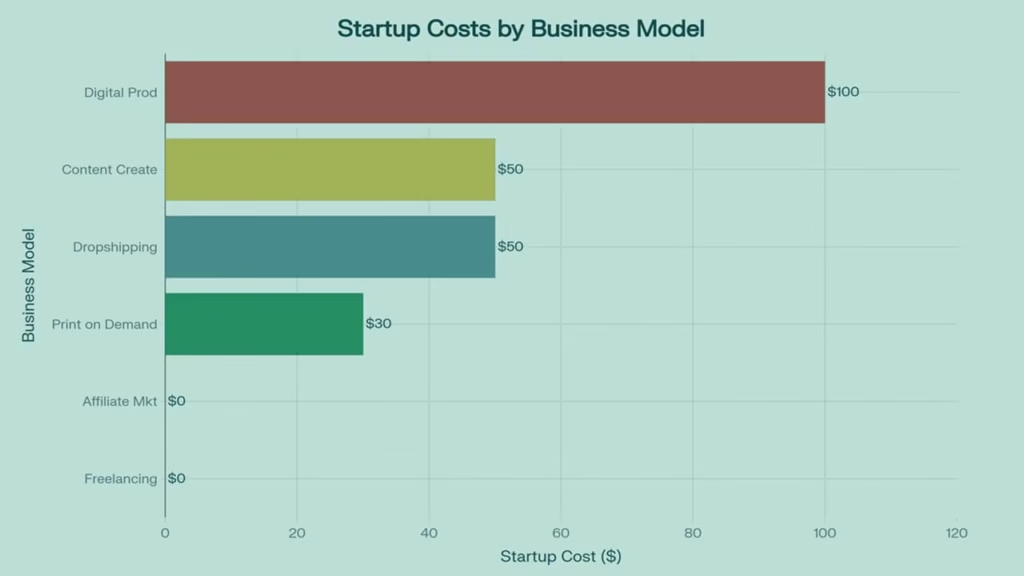
Startup costs for beginner-friendly business models – most requiring little to no upfront investment
The Data Speaks: Experience Isn’t Everything
Research reveals that 87% of entrepreneurs have some form of higher education, but this includes associate degrees and various non-business fields. More importantly, 6% of successful entrepreneurs have only a high school education, proving that formal credentials aren’t mandatory for success.
The startup failure rate of 90% isn’t primarily caused by lack of experience – it’s due to factors like poor market research, inadequate funding, and failure to solve real customer problems. These are all learnable skills that can be developed through research, mentorship, and iterative testing.
Your Advantages as a Newcomer

The Power of Beginner’s Mind
Fresh perspective often trumps industry experience when it comes to innovation. Newcomers approach problems without the baggage of “that’s how we’ve always done it” thinking. This beginner’s mind – a concept from Zen Buddhism that emphasizes openness and lack of preconceptions – can be your secret weapon.
Consider how Melanie Perkins approached design software. As a part-time teacher frustrated with complex design tools, she had no background in software development. Her inexperience actually helped her envision Canva – a simple, intuitive design platform that industry veterans might have dismissed as “too simple.” After being rejected by over 100 investors, her outsider vision eventually created a company now serving 60 million users across 190 countries.
Breaking Industry Rules Creates Breakthroughs
Industry newcomers aren’t constrained by established rules, making them more likely to create disruptive solutions. When you don’t know what’s “impossible,” you’re free to attempt it.
Richard Branson’s Virgin empire exemplifies this advantage. Dropping out of high school at 16 due to dyslexia, Branson had no formal training in aviation, music, or telecommunications. His inexperience became an asset – he questioned everything and rebuilt industries from the customer’s perspective rather than the industry’s.
Willingness to Learn and Adapt
Inexperienced entrepreneurs often display higher learning agility than their experienced counterparts. Without established habits or rigid thinking patterns, newcomers are more willing to:
- Pivot quickly when initial assumptions prove wrong
- Embrace feedback from customers and mentors
- Experiment with new approaches without attachment to previous methods
- Question conventional wisdom rather than accepting it blindly
This adaptability proved crucial for Jeff Bezos when starting Amazon. Despite his Wall Street background, he had no retail experience when he began selling books online from his garage. His willingness to learn and continuously adapt helped Amazon evolve from a simple online bookstore into a global e-commerce and cloud computing giant.
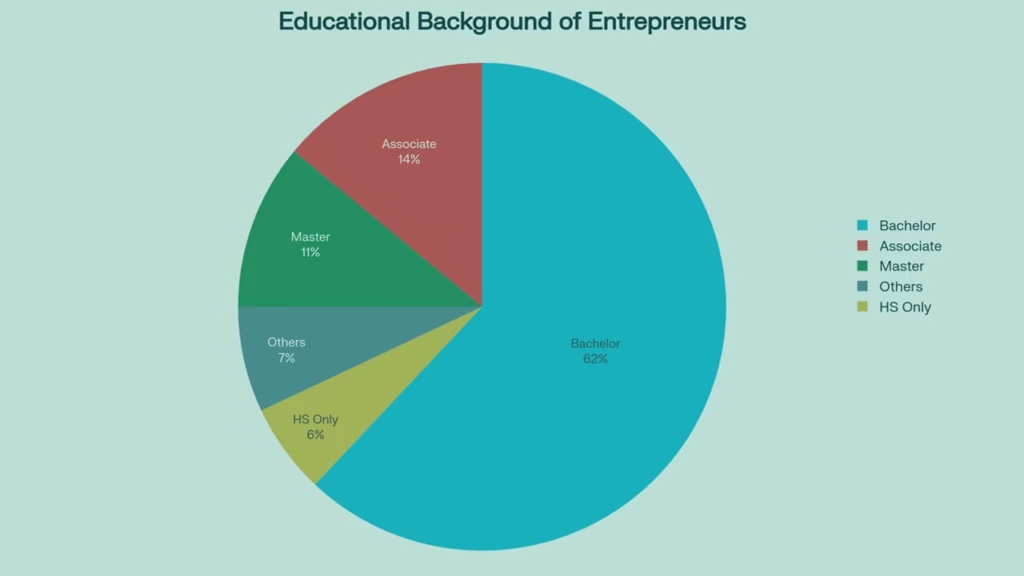
Educational background distribution among entrepreneurs, showing that while many have degrees, formal education isn’t mandatory for success
Common Fears and How to Move Past Them

Conquering Impostor Syndrome
Impostor syndrome affects up to 70% of people, and it’s particularly common among new entrepreneurs who feel like they’re “faking it” until they make it. The key is recognizing that this feeling is normal and doesn’t reflect your actual capabilities.
Practical strategies to overcome impostor syndrome:
- Separate feelings from facts – Just because you feel unqualified doesn’t mean you are
- Document your wins – Keep a record of positive feedback, successful projects, and lessons learned
- Talk about it – Sharing your concerns with mentors or fellow entrepreneurs often reveals how common these feelings are
- Reframe your narrative – Instead of “I don’t belong here,” try “I’m here to learn and contribute”
Remember that every successful entrepreneur started as a beginner. Even industry giants like Steve Jobs admitted to making things up as they went along.
Overcoming Analysis Paralysis
Analysis paralysis – the trap of endless research without action – often affects aspiring entrepreneurs who want to minimize risk. While preparation is important, perfectionism can prevent you from ever starting.
Strategies to break free from analysis paralysis:
- Set decision deadlines with default options
- Start with minimum viable products rather than perfect solutions
- Use the 80/20 rule – make decisions with 80% of the information you think you need
- Embrace “good enough” as a starting point you can improve later
Colonel Sanders didn’t perfect his chicken recipe before starting – he began selling it at a service station and refined it over time. His willingness to start imperfectly eventually built the KFC empire.
Moving Past Fear of Mistakes
Fear of failure often paralyzes potential entrepreneurs, but mistakes are essential learning tools rather than endpoints. Research shows that entrepreneurs who’ve experienced failures are actually 30% more likely to succeed in their next venture because they’ve learned from their mistakes.
Reframe your relationship with failure:
- View mistakes as data that inform better decisions
- Start small to minimize the cost of learning
- Focus on progress over perfection
- Celebrate learning as much as winning
Step-By-Step: How to Start a Business with No Experience
Step 1: Assess Your Starting Point
Begin where you are, not where you think you should be. Conduct an honest inventory of your current situation:
Skills and Strengths Assessment:
- What tasks do people frequently ask for your help with?
- What activities energize rather than drain you?
- What problems do you naturally notice and want to solve?
- What knowledge do you have that others might find valuable?
Resource Inventory:
- How much time can you realistically dedicate?
- What’s your available budget (even if it’s zero)?
- Who in your network might offer advice or support?
- What tools or equipment do you already have access to?
Step 2: Conduct Market Research Using Free Resources
Thorough market research costs nothing but time and can save you from costly mistakes. Use these free tools and methods:
Digital Research Tools:
- Google Trends – Identify growing interest in topics
- Reddit and forums – Find real conversations about problems people face
- Social media groups – Observe what people complain about or request
- Competitor websites – Analyze what others are doing and find gaps
Primary Research Methods:
- Conduct informal interviews with potential customers
- Create simple surveys using Google Forms
- Observe problems in your daily life and community
- Test assumptions with small experiments
Step 3: Choose a Low-Investment Business Model
Start with business models that require minimal upfront capital but offer legitimate earning potential:
Dropshipping ($0-50 startup cost):
- Sell products without holding inventory
- Suppliers handle storage and shipping
- Focus on marketing and customer service
- Can be started with free trials from platforms like Shopify
Print-on-Demand ($0-30 startup cost):
- Create custom designs for products
- Items are printed only when ordered
- No inventory or shipping responsibilities
- Platforms like Printful handle fulfillment
Service-Based Business ($0 startup cost):
- Monetize skills you already have
- Offer consulting, tutoring, or freelance services
- Immediate income potential
- Use existing knowledge and experience
Step 4: Create a Simple Business Plan
A business plan doesn’t need to be complex to be effective. Focus on answering key questions:
Essential Components:
- Problem and Solution – What specific problem are you solving?
- Target Customer – Who exactly needs your solution?
- Value Proposition – Why should customers choose you?
- Revenue Model – How will you make money?
- Marketing Plan – How will you reach customers?
- Financial Projections – What are your expected costs and revenue?
Use free templates from SCORE or the SBA to structure your plan.
Step 5: Build Your Minimum Viable Product (MVP)
Start with the smallest version of your business that can deliver value:
- For service businesses – Offer your service to friends or family first
- For product businesses – Create a simple prototype or use dropshipping
- For digital businesses – Build a basic website or use existing platforms
- For content businesses – Start with free platforms and simple tools
The goal is to start serving customers and learning, not to create something perfect.
Step 6: Find Mentors and Build Your Network
Mentorship can double your chances of success. Research shows that startups with mentors are 70% more likely to survive beyond five years.
How to find mentors:
- SCORE – Free volunteer business mentors across the United States
- Industry associations – Many offer mentorship programs
- Local entrepreneur groups – Meetups and networking events
- Online communities – LinkedIn, Reddit, and industry forums
- University programs – Many offer mentorship to alumni and community members
Common Mistakes to Avoid

Analysis Paralysis: The Perfectionism Trap
Spending months researching instead of testing is one of the biggest mistakes new entrepreneurs make. While preparation matters, action creates more learning than analysis.
Warning signs of analysis paralysis:
- Researching competitors for months without starting
- Constantly changing your business plan
- Waiting for the “perfect” moment to launch
- Seeking endless opinions without making decisions
The antidote: Set launch deadlines and commit to starting with “good enough” rather than perfect.
Ignoring Market Validation
Building something nobody wants is the top reason startups fail. 34% of failed startups cite lack of market need as their primary failure reason.
Avoid this mistake by:
- Talking to potential customers before building anything
- Testing assumptions with small experiments
- Getting paid orders before investing heavily
- Starting with existing demand rather than trying to create it
Underestimating the Value of Feedback
New entrepreneurs often fear negative feedback, but customer input is invaluable for improvement. Embrace feedback as free market research that guides your development.
Create feedback loops through:
- Regular customer surveys
- Social media engagement
- Customer service interactions
- Product reviews and testimonials
Going It Alone
Isolation kills motivation and limits learning. Even if you’re starting a solo business, build connections with other entrepreneurs, mentors, and potential collaborators.
Mini-Case Studies: Success Without Experience

Case Study 1: The Side Hustle That Became an Empire
Background: A college student with no fashion experience noticed that athletic wear lacked style and functionality for women.
Starting Point: Used $1,000 in savings to create prototypes and tested them with friends and classmates.
Key Decisions:
- Focused on a specific niche (women’s athletic wear)
- Used social media for free marketing
- Reinvested early profits into better materials
Outcome: Built a multi-million dollar activewear brand by graduation.
Lesson: Start small, focus on a specific problem, and use your immediate community for validation and early sales.
Case Study 2: From Unemployed to Digital Agency Owner
Background: Recently laid-off marketing coordinator with no entrepreneurship experience.
Starting Point: Offered social media management services to local businesses for $300/month.
Key Decisions:
- Started with skills from previous job
- Focused on local market initially
- Gradually raised prices as expertise grew
- Hired freelancers to scale
Outcome: Built a 15-person digital agency within three years.
Lesson: Your previous experience has value even if it wasn’t entrepreneurial. Start with what you know and expand from there.
Case Study 3: The Problem-Solver’s Product
Background: A parent frustrated with existing solutions for a common household problem.
Starting Point: Created a simple solution and tested it on Amazon using a basic product listing.
Key Decisions:
- Used Amazon’s infrastructure instead of building own website
- Focused on solving one specific problem well
- Listened to customer feedback for improvements
- Gradually expanded product line
Outcome: Generated over $100,000 in first-year revenue.
Lesson: Personal frustrations often reveal genuine market opportunities. Start simple and let customer demand guide expansion.
Beginner’s Action Checklist & Resources
Week 1: Foundation Setting
- Complete skills and interests assessment
- Identify three potential business ideas
- Research each idea’s market potential
- Talk to five potential customers about their problems
- Choose one idea to pursue further
Week 2: Business Model Development
- Define your target customer clearly
- Outline your value proposition
- Choose your business model (service, product, digital, etc.)
- Create a simple one-page business plan
- Set up basic legal structure (LLC, etc.)
Week 3: MVP Creation
- Build your minimum viable product or service
- Create simple website or online presence
- Set up payment processing
- Establish basic operations workflow
- Prepare marketing materials
Week 4: Launch and Learn
- Launch to friends and family first
- Get your first five paying customers
- Collect detailed feedback
- Track key metrics (sales, costs, customer satisfaction)
- Plan improvements based on learnings
Essential Free Resources
Business Planning:
- SCORE Business Plan Templates
- SBA Business Planning Guides
- Lean Canvas Template (online)
Market Research:
- Google Trends
- Reddit and industry forums
- Local Small Business Development Centers
Learning and Development:
- Coursera and edX free business courses
- YouTube educational channels
- Podcasts like “How I Built This” and “Masters of Scale“
Networking and Mentorship:
- SCORE volunteer mentors
- Local entrepreneur meetups
- LinkedIn industry groups
- Chamber of Commerce events
Tools and Platforms:
- Canva for design
- Mailchimp for email marketing
- Google Workspace for productivity
- Shopify or SquareSpace for e-commerce
FAQ Section
“Do I need a degree or certification to start a business?”
No, formal education is not required to start a business. While 87% of entrepreneurs have some form of higher education, 6% succeed with only high school diplomas. What matters more is your willingness to learn, solve problems, and serve customers effectively.
Many successful entrepreneurs started without relevant degrees:
- Richard Branson (Virgin) dropped out of high school
- Jan Koum (WhatsApp) was largely self-taught
- Sara Blakely (Spanx) had no fashion or business background
“What if I fail?”
Failure is a common part of the entrepreneurial journey, not a reflection of your worth or potential. Consider these facts:
- 90% of startups fail, but many founders go on to create successful businesses
- Entrepreneurs who’ve experienced failure have a 30% higher success rate in subsequent ventures
- Most “overnight successes” actually took years and multiple attempts
Treat failure as education. Each mistake teaches you something valuable about customers, markets, or operations that you can apply to your next attempt.
“Can I really compete with experienced players?”
Yes, newcomers often have significant advantages over established players:
Your advantages:
- Fresh perspective unencumbered by “how things are done”
- Agility to pivot quickly when experienced competitors move slowly
- Direct customer focus without legacy systems or bureaucracy
- Willingness to embrace new technologies and approaches
Airbnb competed with the entire hotel industry by seeing hospitality differently. Uber challenged taxi companies by reimagining transportation. Both were started by newcomers who succeeded precisely because they weren’t constrained by industry experience.
“What’s better: learning everything first or jumping in?”
The best approach balances learning with action. Here’s the optimal sequence:
Learn enough to start (80% rule):
- Understand your target market
- Validate your business idea
- Know basic legal and financial requirements
- Have a simple business plan
Then jump in and learn by doing:
- Start with a minimum viable product
- Get real customer feedback
- Adjust based on market response
- Scale what works, eliminate what doesn’t
Continuous learning while operating is more effective than trying to learn everything before starting. Markets change, customer needs evolve, and real-world experience teaches lessons no book can provide.
“Where do I find help if I get stuck?”
Help is available at every stage of your entrepreneurial journey:
Free Resources:
- SCORE mentors – Experienced business volunteers
- Small Business Development Centers – Government-funded counseling
- SBA resources – Guides, templates, and funding information
- Online communities – Reddit, Facebook groups, LinkedIn
Professional Help:
- Attorneys for legal structure and contracts
- Accountants for financial planning and taxes
- Marketing consultants for growth strategies
- Industry associations for networking and education
The key is asking for help before you’re drowning, not after. Most entrepreneurs are willing to help newcomers because they remember getting help when they started.
Your Journey Starts Today
Every entrepreneurial giant started exactly where you are now – with an idea, some uncertainty, and the courage to begin. The difference between dreamers and doers isn’t experience, credentials, or perfect conditions. It’s the willingness to start with what you have and learn as you go.
Your inexperience isn’t a liability – it’s your secret weapon. While others are constrained by industry conventions, you’re free to reimagine solutions. While they’re paralyzed by knowing all the ways things can go wrong, you’re energized by the possibilities of what could go right.
The best time to start was yesterday. The second-best time is now. Your future customers are waiting for the solution only you can provide. Your unique perspective, combined with determination and willingness to learn, is exactly what the market needs.
Take the first step today. Choose one idea from your assessment, talk to one potential customer, or draft one simple business plan. Remember: you don’t need to see the whole staircase to take the first step.
The entrepreneurial journey of a thousand miles begins with a single action. What will yours be?
Remember: Every expert was once a beginner. Every pro was once an amateur. Every icon was once an unknown. The only difference between you and successful entrepreneurs is that they started before they felt ready. Your journey to business success begins the moment you decide that inexperience isn’t a barrier – it’s a beginning.
This article forms part of our series, “Frequently Asked Questions (FAQs) About Starting Online,” providing you with clear, actionable guidance to launch and grow your digital business with confidence.