

The entrepreneurial journey presents a fundamental challenge that can make or break your business: how do you balance the need to learn with the imperative to act? This question haunts countless entrepreneurs, side hustlers, and small business owners who find themselves trapped between endless research and hasty execution—in other words, wondering how to balance learning and doing. The answer isn’t choosing one over the other—it’s mastering the art of strategic balance.
This comprehensive guide will transform how you approach learning and doing in your business, providing practical frameworks, proven strategies, and actionable insights to help you avoid analysis paralysis while building the knowledge foundation your venture needs to thrive.
The 80/20 Learning Framework: How Entrepreneurs Should Balance Learning vs. Doing
Why Learning and Doing Both Matter for Business Success

The most successful entrepreneurs understand that learning and doing aren’t competing priorities—they’re complementary forces that amplify each other when properly balanced. Research shows that entrepreneurs who combine structured learning with rapid experimentation are 52% less likely to scale prematurely and raise 2.5x more money than those who favor one approach exclusively.
Learning provides the strategic foundation your business needs. It helps you understand market dynamics, avoid costly mistakes that others have made, develop essential skills, and make informed decisions based on proven frameworks. Without adequate learning, you’re essentially flying blind, vulnerable to preventable errors that could derail your venture.
Doing generates the real-world feedback that transforms theoretical knowledge into practical wisdom. It creates momentum, builds confidence, validates assumptions, and provides the tangible results that attract customers and investors. Execution allows you to test ideas quickly, iterate based on actual market response, and develop the resilience that comes from overcoming real challenges.
The magic happens when these two elements work in harmony. Entrepreneurs who master this balance can pivot quickly when needed, scale efficiently without losing sight of fundamentals, and build sustainable businesses that adapt to changing market conditions.
Common Pitfalls: Analysis Paralysis vs. Action Without Insight

Understanding the dangers of extremes is crucial for finding the right balance. Most entrepreneurs fall into one of two traps, both of which can be fatal to business success.
The Analysis Paralysis Trap
Analysis paralysis occurs when the fear of making wrong decisions outweighs the realistic expectation of success. This condition manifests in several destructive ways:
Information addiction becomes a common symptom, where entrepreneurs consume endless content—blogs, podcasts, courses—without ever applying what they learn. They spend more than three hours daily consuming information, accumulate multiple unfinished courses, and research extensively before making even small decisions.
Learning Doing Frameworks Comparison
The perfectionism curse prevents entrepreneurs from launching because they believe they need to learn “just one more thing” before they’re ready. They can explain theories perfectly but struggle with practical application, constantly seeking new learning resources instead of using existing knowledge.
Decision fatigue compounds the problem as endless deliberation depletes mental energy, making even simple choices feel overwhelming. Studies show that adults make over 30,000 decisions daily, and entrepreneurs face particularly complex choices that can lead to mental and emotional exhaustion when over-analyzed.
The Action Without Insight Trap
On the opposite extreme, some entrepreneurs jump into execution without building adequate knowledge foundations. This approach creates its own set of problems:
Repeated mistakes become the norm when entrepreneurs resist taking time to learn from others’ experiences. They make the same errors repeatedly without reflection, dismissing learning as “too academic” or a “waste of time”.
Resource waste occurs when entrepreneurs implement solutions without understanding underlying principles. They feel like they’re constantly putting out fires, struggle to explain why certain strategies work, and get frustrated when results don’t come immediately.
Strategic blindness develops when entrepreneurs focus solely on immediate tasks without understanding broader market dynamics. They miss opportunities to leverage proven frameworks and fail to recognize patterns that could accelerate their growth.
Practical Frameworks for Daily and Weekly Balance
The key to balancing learning and doing lies in structured approaches that allocate time and energy strategically. Here are three proven frameworks that successful entrepreneurs use to optimize both learning and execution.
The 80/20 Learning Framework
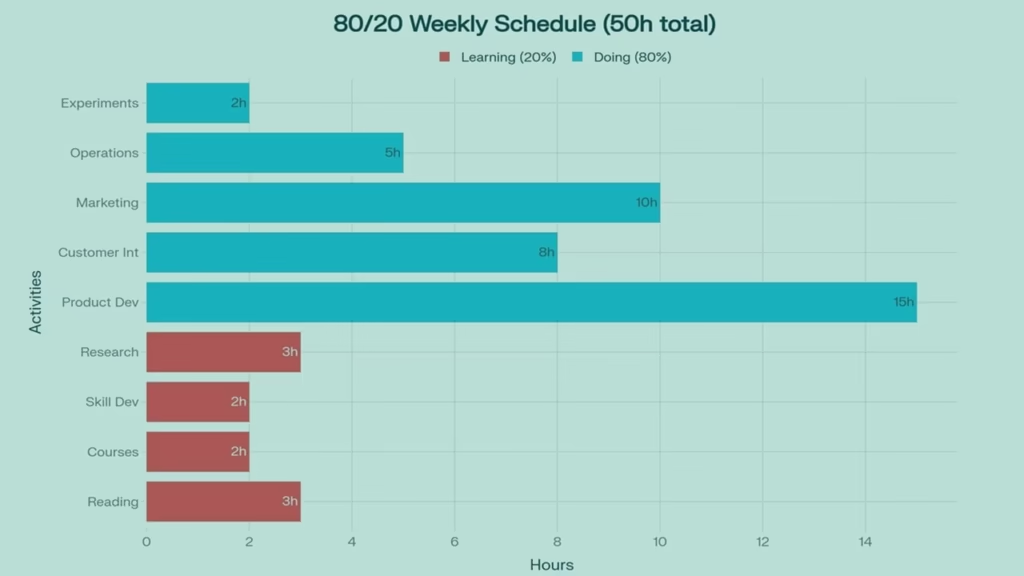
The most widely adopted approach among successful entrepreneurs is the 80/20 rule applied to learning versus doing. This framework dedicates 80% of your time to execution and 20% to structured learning, ensuring you maintain forward momentum while continuously building knowledge.
Weekly time allocation breaks down as follows: 10 hours for learning activities (reading industry content, online courses, market research, skill development) and 40 hours for execution activities (product development, customer interviews, marketing, operations, experimentation). This distribution ensures you’re always making tangible progress while building the knowledge base needed for informed decisions.
Learning activities should focus on just-in-time knowledge acquisition—learning only what you need for your next immediate action or milestone. This might include researching specific customer segments before launching targeted campaigns, learning new marketing techniques before major promotional pushes, or studying competitors’ strategies before product launches.
Execution activities should be designed to generate immediate feedback and results. Prioritize customer interviews, product development, marketing campaigns, and business operations that move your venture forward while providing data for future learning.
The Learn-Do-Reflect Cycle
This comprehensive approach dedicates equal attention to learning, doing, and reflection, making it ideal for new entrepreneurs in complex industries. The cycle allocates 30% of time to learning, 40% to execution, and 30% to analysis and reflection.
The learning phase focuses on acquiring specific knowledge needed for upcoming actions. This might involve studying customer personas before launching campaigns, researching pricing strategies before setting rates, or learning about legal requirements before signing contracts.
The doing phase emphasizes implementation and experimentation. Take the knowledge gained and immediately apply it to real business situations. Run small-scale tests, conduct customer interviews, launch pilot programs, and measure results systematically.
The reflection phase analyzes results and extracts lessons for future application. Document what worked, what didn’t, and why. Update your assumptions based on real-world feedback and plan the next learning-doing cycle based on insights gained.
Time Blocking for Learning and Execution
Time blocking provides structure for entrepreneurs juggling multiple projects and priorities. This approach schedules specific blocks for different types of activities, ensuring both learning and doing receive adequate attention.
Learning blocks should be scheduled during your peak mental energy periods. Dedicate focused time slots to reading industry reports, taking online courses, conducting market research, or developing new skills. Treat these blocks as seriously as any business meeting.
Execution blocks focus on high-impact activities that drive business results. Schedule blocks for customer interviews, product development, marketing activities, and sales efforts. These blocks should be defended against interruptions and distractions.
Buffer blocks provide flexibility for unexpected opportunities or challenges. Include time for processing information, transitioning between activities, and handling urgent business needs. This prevents your schedule from becoming too rigid and allows for adaptation.
Strategies to Combine Learning and Doing Effectively

The most successful entrepreneurs don’t just balance learning and doing—they integrate them into a seamless system that accelerates both knowledge acquisition and business growth.
Just-in-Time Learning
Just-in-Time learning revolutionizes how entrepreneurs acquire knowledge by focusing on immediate practical needs rather than theoretical completeness. This approach delivers exactly what you need, right when you need it, maximizing the relevance and application of every learning investment.
Implementation strategy involves identifying specific knowledge gaps only when they become barriers to progress. Instead of comprehensive learning programs, focus on targeted knowledge acquisition that solves immediate business challenges. Learn pricing strategies only when you’re setting prices, study marketing channels only when you’re launching campaigns, and research legal requirements only when you’re signing contracts.
Practical application means learning while doing rather than learning before doing. Read about customer interview techniques while scheduling interviews, study social media marketing while running campaigns, and research fundraising strategies while preparing pitch decks. This ensures knowledge is immediately applied and retained through practical use.
Efficiency benefits include reduced learning time by 30-40% compared to traditional approaches. Just-in-time learning eliminates information overload, increases retention through immediate application, and prevents the accumulation of unused knowledge that creates mental clutter.
Micro-Experiments and Learning Labs
Transform your business into a learning laboratory where every activity generates knowledge while driving results. This approach treats business operations as ongoing experiments that provide data for continuous improvement.
Design micro-experiments that test specific assumptions with minimal investment. Launch small-scale marketing campaigns to test messaging, create simple landing pages to test product concepts, or conduct customer interviews to test pricing strategies. Each experiment should have clear success metrics and defined learning objectives.
Document everything to capture lessons from both successes and failures. Maintain experiment logs that track hypotheses, methods, results, and insights gained. This documentation becomes a valuable knowledge base that informs future decisions and prevents repeated mistakes.
Iterate rapidly based on experimental results. Use insights from each experiment to design better tests, refine business strategies, and improve execution approaches. This creates a continuous learning loop that accelerates both knowledge development and business growth.
The MVP Learning Approach
The Minimum Viable Product (MVP) methodology exemplifies how to learn while doing, allowing entrepreneurs to test core assumptions with real customers while building their businesses.
Start with core hypotheses about your customers, their problems, and your solution’s effectiveness. Build the simplest version of your product that can test these hypotheses with real users. This might be a landing page that tests demand, a manual service that tests problem-solution fit, or a basic prototype that tests core functionality.
Gather feedback continuously from early users and iterate based on their responses. Use customer feedback to refine your product, adjust your strategy, and identify new opportunities. This approach ensures you’re building something people actually want while learning about your market through direct engagement.
Scale learning with growth by treating each business milestone as a learning opportunity. As your business grows, use increased customer interactions, expanded market reach, and operational challenges as sources of valuable insights that inform your strategic decisions.
Self-Assessment: Recognizing When You’re Off Balance

Maintaining the right balance between learning and doing requires ongoing self-awareness and course correction. Use these diagnostic tools to identify when you’ve tilted too far in either direction and need to adjust your approach.
Warning Signs: Stuck in Learning Mode
When learning becomes procrastination in disguise, several symptoms emerge that signal the need for immediate action:
Information consumption patterns reveal the problem when you spend more than three hours daily consuming content through blogs, podcasts, or courses. Multiple unfinished online courses or books indicate you’re seeking new information instead of applying existing knowledge. Extensive research before making small decisions suggests you’re using analysis to avoid the discomfort of action.
Behavioral indicators include postponing launches because you need to learn “just one more thing”. You can explain theories perfectly but struggle with practical application, feel overwhelmed by the amount of information available, and spend more time in online communities discussing ideas than implementing them.
Emotional symptoms manifest as anxiety about taking action without “enough” knowledge. You experience decision fatigue from endless deliberation and feel paralyzed by the gap between what you know and what you think you need to know.
Warning Signs: Stuck in Action Mode
Excessive focus on doing without adequate learning creates its own set of problems that can derail long-term success:
Pattern recognition becomes difficult when you jump into projects without understanding basic principles. Making the same mistakes repeatedly without reflection indicates insufficient learning integration. Rarely seeking advice or learning from others’ experiences suggests dangerous overconfidence in pure execution.
Strategic problems emerge when you get frustrated if results don’t come immediately. Resistance to taking time for planning or research creates a firefighting mentality where you’re always reactive rather than proactive. Struggling to explain why certain strategies work or don’t work reveals gaps in understanding that limit your ability to scale successful approaches.
Growth limitations appear when you dismiss learning as “too academic” or “waste of time”. This attitude prevents you from leveraging proven frameworks, learning from others’ mistakes, and developing the strategic thinking necessary for sustainable business growth.
Signs of Balanced Integration
Healthy balance between learning and doing creates distinct patterns that successful entrepreneurs recognize and cultivate:
Decision-making clarity emerges when you can clearly explain the reasoning behind your actions. You regularly test small experiments before big commitments and seek relevant information only when needed for specific decisions. Reflecting on results and adjusting strategies accordingly becomes natural.
Operational excellence develops through having a mix of learning and doing activities scheduled weekly. You can pivot quickly when new information contradicts your approach and actively seek feedback to incorporate into improvements. Setting learning goals tied to specific business outcomes ensures knowledge acquisition remains purposeful.
Growth mindset indicators include treating both successes and failures as learning opportunities. You maintain curiosity about industry trends while staying focused on execution priorities. Balancing confidence in your abilities with openness to new insights creates sustainable competitive advantages.
How Top Entrepreneurs Balance Learning and Doing
Studying successful entrepreneurs reveals consistent patterns in how they integrate learning and execution to build thriving businesses. These real-world examples provide actionable insights you can apply to your own venture.
Case Study: Airbnb‘s Learning-While-Building Approach
Airbnb‘s founders exemplify how to balance learning and doing through systematic experimentation and customer-focused iteration. When Brian Chesky and Joe Gebbia started the company, they didn’t spend months researching the hospitality industry—they immediately tested their hypothesis by renting air mattresses in their apartment during a design conference.
Their learning approach involved talking directly to both hosts and guests to understand their needs and pain points. Instead of relying on industry reports or theoretical frameworks, they gained insights through direct customer interaction while building their platform. This approach allowed them to learn about their market while simultaneously developing their product.
Execution strategy focused on solving immediate problems while testing broader assumptions. They personally visited hosts to understand challenges, photographed properties to improve listings, and handled customer service directly to identify system improvements. Each operational task became a learning opportunity that informed their product development.
Results and lessons show the power of integrated learning and doing. Airbnb grew from a simple room-sharing concept to a global platform worth billions by continuously learning from user behavior while rapidly implementing improvements. Their success demonstrates how learning and execution can reinforce each other when properly integrated.
Case Study: Dropbox‘s Video-First Validation
Dropbox founder Drew Houston demonstrates how smart entrepreneurs test concepts before building, using learning to inform execution decisions. Instead of spending months developing a complex file-syncing application, Houston created a simple explainer video demonstrating the core functionality.
The learning experiment tested whether people actually wanted the product before investing in development. The video generated massive interest and sign-ups, providing clear evidence of market demand without the cost and time of building the full product. This approach validated core assumptions while gathering user feedback that informed development priorities.
Execution based on learning meant Houston could build with confidence, knowing there was proven demand. The video experiment provided insights about user expectations, desired features, and market positioning that shaped the actual product development. This learning-first approach reduced development risks and accelerated time to market.
Strategic implications show how small experiments can provide big insights. Dropbox‘s video experiment cost minimal time and money but provided invaluable market validation that informed major strategic decisions. This demonstrates how learning activities can be executed quickly and provide high-value insights for execution planning.
Case Study: TaskRabbit‘s Pivot Through Customer Learning
Leah Busque Solivan’s journey with TaskRabbit illustrates how entrepreneurs can use customer feedback to balance theoretical planning with practical market response. The company started as RunMyErrand but evolved through continuous learning about user behavior and market needs.
Learning from user behavior revealed insights that contradicted initial assumptions. Busque Solivan discovered that customers wanted more than simple errand running—they needed a broader range of task assistance. This learning came not from market research but from observing actual user behavior on the platform.
Execution adjustments based on learning led to platform improvements that drove growth. The company rebranded to TaskRabbit and expanded service offerings based on user demand patterns. When the mobile app transition initially failed in the US market, lessons from the successful London launch guided recovery strategies.
Continuous iteration demonstrates how learning and doing create feedback loops that drive improvement. TaskRabbit‘s expansion to multiple countries and services resulted from ongoing learning about user needs combined with systematic execution of platform improvements. This iterative approach built a business that adapted successfully to changing market conditions.
Common Patterns Among Successful Entrepreneurs
Analysis of successful entrepreneurs reveals consistent approaches to balancing learning and doing:
Customer-centric learning prioritizes insights from direct customer interaction over theoretical market research. Successful entrepreneurs spend significant time talking to customers, observing behavior, and testing assumptions with real users. This approach ensures learning is relevant and actionable.
Rapid experimentation allows entrepreneurs to test hypotheses quickly and cheaply before making major commitments. They design small-scale experiments that provide clear data about market response, product viability, and growth strategies. This approach reduces risks while accelerating learning.
Systematic reflection transforms experiences into knowledge that informs future decisions. Successful entrepreneurs document lessons learned, analyze patterns in their successes and failures, and use these insights to improve their approaches. This creates a feedback loop that continuously improves both learning and execution effectiveness.
Avoiding Burnout and Information Overload

The pressure to constantly learn while maintaining execution momentum can lead to burnout if not managed properly. Successful entrepreneurs develop systems to maintain sustainable learning and doing practices without sacrificing their well-being or business performance.
Setting Boundaries and Limits
Effective boundary-setting prevents both information overload and execution fatigue from derailing your entrepreneurial progress.
Information consumption limits help prevent the overwhelming feeling that comes from trying to absorb everything available. Set specific times for checking emails, reading industry content, and consuming educational materials. Limit yourself to 2-3 trusted sources per type of information you need, avoiding the temptation to constantly seek new sources.
Decision-making timeboxes prevent analysis paralysis while ensuring adequate consideration. Put time limits on information gathering for specific decisions—one hour for minor choices, one day for moderate decisions, one week for major strategic choices. When the timebox expires, make the best decision with available information rather than continuing to research indefinitely.
Work-life integration protects your mental energy for both learning and doing. Set clear work hours and stick to them, schedule regular breaks during learning and execution activities, and maintain physical health through proper diet, sleep, and exercise. Your brain needs rest to process information effectively and maintain decision-making quality.
Choosing Quality Over Quantity
Information overload often results from trying to learn everything instead of focusing on what’s most relevant and actionable.
Curated learning sources provide higher value than scattered information consumption. Identify industry experts whose perspectives align with your business needs and follow them consistently rather than sampling from hundreds of sources. Choose one primary course, book, or program at a time instead of juggling multiple learning resources simultaneously.
Just-enough learning focuses on acquiring knowledge only when it’s needed for specific actions. Learn about customer acquisition channels only when you’re ready to launch marketing campaigns, study pricing strategies only when you’re setting prices, and research legal requirements only when you’re ready to make commitments. This approach prevents information accumulation that creates mental clutter without providing immediate value.
Action-oriented filtering evaluates information based on its immediate applicability to your business challenges. Ask yourself: “Can I apply this knowledge within the next week?” If not, bookmark it for later rather than consuming it immediately. Focus your attention on information that directly supports your current execution priorities.
Creating Sustainable Learning Habits
Sustainable learning practices maintain knowledge growth without creating overwhelm or burnout.
Scheduled learning time treats knowledge acquisition as seriously as business meetings. Block specific times for learning activities and protect them from interruptions, just as you would protect time with important customers or investors. This ensures learning happens consistently without competing with execution priorities.
Active application practice reinforces learning through immediate implementation. After each learning session, identify at least one specific action you can take based on new knowledge. Apply new social media strategies to actual campaigns, test pricing insights with real customers, or implement productivity techniques in your daily routine.
Reflection and integration transforms information into wisdom through systematic analysis. Schedule weekly reviews to assess what you’ve learned and how it’s impacted your business results. Document insights that proved valuable and identify knowledge gaps that need attention. This practice ensures learning contributes meaningfully to your business growth.
Your Balanced Action Plan: Implementation Checklist

Transform the concepts in this guide into a practical system that accelerates your business growth while building essential knowledge. Use this comprehensive checklist to implement balanced learning and doing practices immediately.
Week 1-2: Foundation Setup
Assess your current balance using the self-assessment framework provided earlier:
- ✅ Count signs from learning mode, action mode, and balanced mode categories
- ✅ Identify which pattern most closely matches your current approach
- ✅ Document specific areas where you’re spending too much or too little time
- ✅ Set initial targets for rebalancing your time allocation
Choose your primary framework based on your business stage and needs:
- ✅ Select 80/20 rule for established businesses needing more execution focus
- ✅ Choose learn-do-reflect cycle for new entrepreneurs in complex industries
- ✅ Implement time blocking for busy entrepreneurs managing multiple projects
- ✅ Create a weekly schedule template based on your chosen framework
Establish learning boundaries to prevent information overload:
- ✅ Limit information sources to 2-3 trusted resources per topic area
- ✅ Set specific times for email and content consumption
- ✅ Create decision-making timeboxes for different types of choices
- ✅ Schedule regular breaks and protect work-life boundaries
Week 3-4: Implementation and Testing
Design your first learning experiments using just-in-time principles:
- ✅ Identify one immediate business challenge requiring new knowledge
- ✅ Find specific, actionable information sources for this challenge
- ✅ Set a learning timebox (2-4 hours maximum for initial experiments)
- ✅ Plan immediate application of the knowledge gained
Launch micro-experiments to test business assumptions:
- ✅ Choose one business hypothesis to test with minimal investment
- ✅ Design a simple experiment with clear success metrics
- ✅ Execute the experiment and document results systematically
- ✅ Extract lessons that inform your next learning or doing priorities
Track your balance using simple metrics:
- ✅ Log time spent on learning vs. doing activities daily
- ✅ Note your energy levels and decision-making quality
- ✅ Record business progress and learning insights weekly
- ✅ Identify patterns that suggest needed adjustments
Week 5-8: Optimization and Scaling
Refine your approach based on initial results:
- ✅ Analyze which learning methods provided the most applicable insights
- ✅ Identify which doing activities generated the best business results
- ✅ Adjust your time allocation based on what’s working best
- ✅ Eliminate learning or doing activities that aren’t providing value
Scale successful experiments while maintaining balance:
- ✅ Expand experiments that provided valuable insights or business results
- ✅ Document successful learning-doing combinations for future use
- ✅ Share insights with mentors, advisors, or peer entrepreneurs
- ✅ Plan next-level experiments based on current results
Build sustainable systems for long-term success:
- ✅ Create standard templates for future learning experiments
- ✅ Establish regular reflection and review practices
- ✅ Build a personal knowledge base for future reference
- ✅ Develop accountability systems to maintain balance over time
Monthly Review and Adjustment Process
Evaluate business progress against learning and doing investments:
- ✅ Measure business metrics like revenue, customers, and product development
- ✅ Assess skill development and knowledge growth over the month
- ✅ Identify correlations between learning activities and business results
- ✅ Recognize areas where better balance could accelerate progress
Plan the next month based on lessons learned:
- ✅ Set specific learning goals tied to business objectives
- ✅ Schedule execution priorities that apply recent knowledge
- ✅ Identify knowledge gaps that could limit upcoming business activities
- ✅ Adjust your framework based on changing business needs
Take Action Today: Your Next Steps

The difference between successful entrepreneurs and those who struggle isn’t perfect knowledge or flawless execution—it’s the ability to balance learning and doing effectively. You now have the frameworks, strategies, and tools needed to master this balance in your own business.
Start immediately with one small action from this guide. Choose the self-assessment tool to understand your current balance, implement the 80/20 framework for next week’s schedule, or design your first micro-experiment to test a business assumption. Perfect balance comes through practice, not planning.
Remember the fundamental truth: you don’t need to know everything before you start, and you can’t learn everything by doing alone. The most successful entrepreneurs are those who combine strategic learning with bold action, creating businesses that adapt, grow, and thrive in changing markets.
Your business success depends not on choosing between learning and doing, but on mastering the art of doing both simultaneously. The frameworks in this guide will help you build that mastery, one balanced day at a time.
The question isn’t whether you should learn or do—it’s how quickly you can start doing both better. Your next breakthrough is waiting on the other side of this balance.
This article forms part of our series, “Frequently Asked Questions (FAQs) About Starting Online,” providing you with clear, actionable guidance to launch and grow your digital business with confidence.