

Finding the right side hustle isn’t just about chasing the latest trend or picking something that seems profitable. The most successful side hustlers—those who build sustainable, fulfilling, and profitable ventures—understand a fundamental truth: success comes from aligning your natural skills with your genuine passions while meeting real market demand.
In today’s economy, where 36% of Americans have a side hustle and earn an average of $530-891 monthly, the competition is fierce. But here’s the encouraging news: 97% of side hustlers avoid failure when they take the right approach. The key difference? They start with a thorough assessment of their skills and passions before diving into any business opportunity.
This comprehensive guide will walk you through a proven, step-by-step process for assessing your skills and passions, discovering your unique strengths, and finding that sweet spot where they intersect with market opportunity.
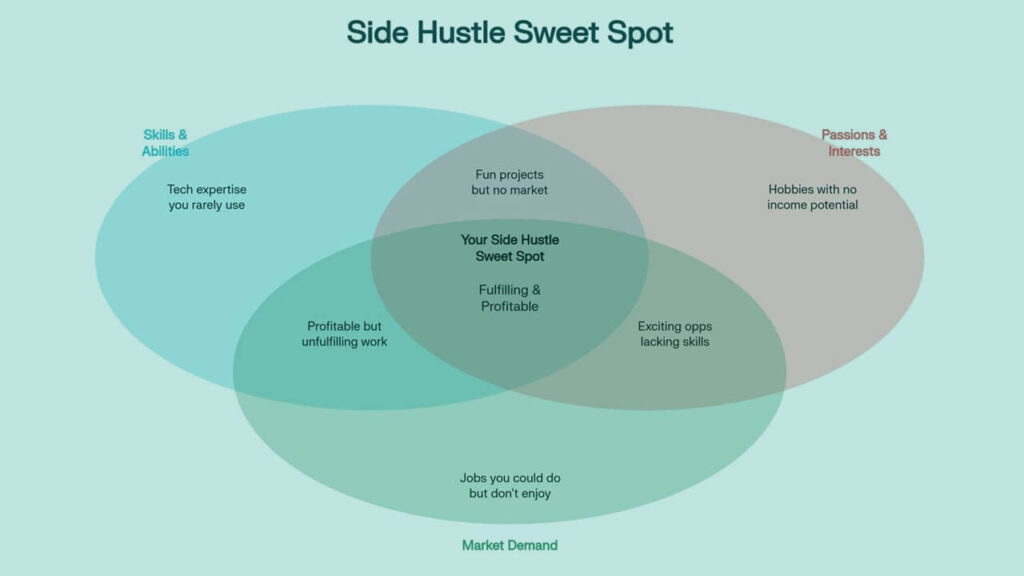
The Side Hustle Sweet Spot: Finding the intersection of your skills, passions, and market demand
Why Assess Your Skills and Passions First?

The Power of Alignment
Research consistently shows that passionate employees are more engaged, resilient, and committed, often outperforming those who are merely “qualified”. When applied to side hustles, this principle becomes even more powerful. Consider these compelling statistics:
- 61% of side hustlers increased their income by at least 10% in the last 12 months
- Those with passion-based side hustles report significantly higher income levels
- 80% of side hustlers started their ventures primarily to increase income, but 27% began to explore a passion
The most successful side hustlers understand that passion isn’t just a nice-to-have—it’s a critical success factor. As one expert notes, “Passion is the underlying force that will take you to the place you want to go and as result skills will develop”.
Beyond Motivation: The Strategic Advantage
Starting with skills and passion assessment provides several strategic advantages:
1. Sustainable Motivation: When you’re working on something you genuinely care about, the inevitable challenges become easier to overcome. Time management is the biggest challenge for side hustlers, with 31-40% quitting due to time constraints. Those aligned with their passions find it easier to prioritize their side hustle time.
2. Authentic Marketing: Authentic passion resonates with customers. 44% of young entrepreneurs use social media as their primary marketing tool, and 32% credit social media as the key driver of their business success. Genuine enthusiasm for your topic translates into more engaging content and stronger customer connections.
3. Skill Development Acceleration: When you’re passionate about something, you naturally invest more time and energy in improving. This creates a positive feedback loop where your skills grow rapidly, making you more competitive in the marketplace.
4. Higher Success Rates: Studies show that entrepreneurs who align their ventures with their core strengths and interests are more likely to persist through challenges and achieve long-term success.
Taking Stock: Ways to Inventory Your Skills

Understanding Hard vs. Soft Skills
Before diving into the assessment process, it’s crucial to understand the different types of skills you possess. Skills assessment is fundamental to making informed career and business decisions.
Hard Skills are specific, teachable abilities that can be defined and measured. These include:
- Technical competencies (software, programming, design tools)
- Specialized knowledge (languages, certifications, industry expertise)
- Measurable abilities (typing speed, mathematical skills, equipment operation)
Soft Skills are personal attributes and interpersonal abilities that determine how you work. These include:
- Communication and leadership abilities
- Problem-solving and critical thinking
- Time management and organization
- Emotional intelligence and adaptability
Transferable Skills bridge the gap between different industries and roles. These versatile abilities include:
- Project management and planning
- Customer service and relationship building
- Analysis and research capabilities
- Creative problem-solving approaches
The Comprehensive Skills Audit Process

Step 1: Experience-Based Skills Mapping
Start by analyzing your past experiences systematically. Skills come from various areas of our lives, including:
Employment History:
- List every job, internship, or freelance project
- Identify specific tasks and responsibilities
- Note achievements and recognition received
- Consider both your official duties and informal contributions
Educational Background:
- Academic projects and research
- Group work and leadership roles
- Technical skills learned
- Subjects where you excelled
Volunteer Work and Community Involvement:
- Leadership positions held
- Projects managed or contributed to
- Skills developed through service
- Recognition or impact achieved
Personal Projects and Hobbies:
- Creative endeavors and artistic pursuits
- Personal challenges you’ve overcome
- Skills developed through interests
- Communities you’ve built or joined
Step 2: The 360-Degree Feedback Approach
Self-assessment alone can be incomplete. As research shows, 72% of small firm owners lack an accurate view of their entrepreneurial skills. To get a complete picture:
- Survey Close Contacts: Ask family, friends, and colleagues what they see as your strongest skills
- Professional Input: Seek feedback from supervisors, mentors, or professional contacts
- Customer/Client Perspectives: If you’ve done any client work, gather feedback on your strengths
- Peer Reviews: Connect with others in your field for honest assessments
Step 3: Skills Assessment Tools and Frameworks
Utilize structured assessment tools to ensure comprehensive coverage:
Professional Skills Inventory:
Use frameworks like the Entrepreneurial Skills Assessment which evaluates dimensions including:
- Research and analytical abilities
- Communication and presentation skills
- Leadership and management capabilities
- Technical and specialized competencies
- Creative and innovative thinking
- Interpersonal and networking skills
Online Assessment Platforms:
- National Career Service skills assessments
- Professional competency evaluations
- Industry-specific skill tests
- Personality-based assessments that reveal natural strengths
Uncovering Your Passions and Interests

Beyond Surface-Level Interests
True passion goes deeper than casual interest. Passions are powerful feelings of enthusiasm about a task or activity. They represent what you could spend hours engaged in without feeling drained—activities that actually energize you.
Research shows that passionate professionals tend to stay longer in their careers and accumulate greater wealth over time, challenging the notion that passion and financial security are mutually exclusive.
The Deep Dive Discovery Process
Reflection-Based Discovery
1. Energy Assessment Questions:
- What activities make you lose track of time?
- When do you feel most energized and alive?
- What topics could you discuss for hours without getting bored?
- What problems in the world genuinely frustrate you enough to want to solve them?
2. Historical Pattern Analysis:
- What did you love doing as a child that still interests you?
- What accomplishments are you most proud of, and why?
- When have you felt most fulfilled in work or personal projects?
- What activities do others say you “light up” when discussing?
3. Values Alignment Exercise:
Identify your core values and examine how they connect to potential passions:
- Financial security vs. creative expression
- Helping others vs. personal achievement
- Independence vs. collaboration
- Stability vs. adventure and variety
The “Five Whys” Technique
For each potential passion area, dig deeper by asking “why” five times:
Example:
- I’m interested in fitness
- Why? Because I feel great when I exercise
- Why does that matter? Because it gives me energy and confidence
- Why is that important? Because it helps me perform better in all areas of life
- Why does that drive you? Because I want to help others experience that same transformation
- Why is that your calling? Because I believe everyone deserves to feel strong and confident in their body
This process reveals the deeper motivations behind surface interests.
The Passion Validation Framework
Not all interests translate into viable business passions. Use this framework to evaluate potential passions:
Intensity Test:
- Does thinking about this area genuinely excite you?
- Would you pursue this even if immediate financial rewards weren’t guaranteed?
- Do you find yourself naturally learning more about this topic?
Sustainability Assessment:
- Can you see yourself engaged in this area for years, not just months?
- Does your interest remain strong even when facing challenges?
- Do you have the emotional resilience to handle setbacks in this area?
Growth Potential:
- Are there aspects of this passion you haven’t yet explored?
- Does the field offer opportunities for continuous learning and development?
- Can you envision multiple ways to engage with this passion professionally?
Finding the Intersection: Your “Sweet Spot”

The Three-Circle Framework
The most successful side hustles exist at the intersection of three critical elements:
- Skills & Abilities: What you’re genuinely good at or can become excellent at
- Passions & Interests: What energizes and motivates you
- Market Demand: What people actually need and will pay for
This intersection—your “Sweet Spot”—represents the optimal zone for building a sustainable, profitable, and fulfilling side hustle.
Analyzing Each Intersection
Skills + Passions (No Market): These often become fulfilling hobbies but may lack income potential. Example: You love writing poetry and are skilled at it, but there’s limited market demand for poetry.
Skills + Market (No Passion): This creates profitable but potentially unfulfilling work. Example: You’re excellent at data entry and there’s market demand, but you find the work draining.
Passions + Market (No Skills): Exciting opportunities that need skill development. Example: You’re passionate about sustainable living and there’s market demand, but you need to develop expertise in specific areas like solar installation or sustainable product design.
The Sweet Spot (All Three): This is where magic happens. Example: You love helping people get organized (passion), you’re naturally good at creating systems (skill), and busy professionals will pay for organizational services (market).
The Sweet Spot Discovery Exercise
Step 1: List Your Top Assets
From your skills assessment, identify your top 5 strongest skills
From your passion discovery, identify your top 5 strongest interests
Step 2: Create Combination Scenarios
Systematically combine each skill with each passion to generate potential side hustle ideas:
Example Combinations:
- Writing Skills + Fitness Passion = Fitness blog, workout program creation, health coaching content
- Design Skills + Sustainability Passion = Eco-friendly branding, sustainable product packaging, environmental awareness campaigns
- Teaching Skills + Technology Passion = Online course creation, tech tutorials, digital literacy training
Step 3: Market Validation Quick Check
For each promising combination, ask:
- Who would pay for this solution?
- What specific problem does this solve?
- How much might people realistically pay?
- What’s the competition level in this space?
Sample Sweet Spot Scenarios
Scenario 1: Maria’s Discovery
- Skills: Marketing experience, excellent writing, social media management
- Passions: Helping small businesses succeed, creative storytelling
- Market Intersection: Social media marketing for local businesses
- Sweet Spot: Specializing in storytelling-based social media strategies for local restaurants and retail stores
Scenario 2: James’s Journey
- Skills: Project management, problem-solving, communication
- Passions: Home improvement, helping families, creating functional spaces
- Market Intersection: Home organization consulting
- Sweet Spot: Offering project management services for home renovation and organization projects
Scenario 3: Sarah’s Success
- Skills: Teaching, patience, technology troubleshooting
- Passions: Lifelong learning, empowering seniors, bridging generational gaps
- Market Intersection: Technology training for seniors
- Sweet Spot: In-home tech support and training services for older adults
Validating With Your Network and Real-World Feedback

The Validation Imperative
Before investing significant time or money in any side hustle idea, validation is crucial. Most side hustles become profitable within 3-6 months, but only when there’s genuine market demand.
Network-Based Validation Strategies
The Advisory Circle Approach
Identify 5-7 people who can provide different perspectives:
- Industry Insider: Someone working in your target market
- Ideal Customer: Someone who fits your target customer profile
- Business Mentor: An experienced entrepreneur or business professional
- Skeptical Friend: Someone who will challenge your assumptions
- Subject Matter Expert: Someone with deep knowledge in your passion area
Structured Feedback Conversations
Rather than asking “What do you think of my idea?”, use specific questions:
For Potential Customers:
- “What’s your biggest challenge with [relevant problem area]?”
- “How do you currently solve [specific problem]?”
- “What would an ideal solution look like to you?”
- “How much time/money do you currently spend on this?”
For Industry Experts:
- “What trends are you seeing in this space?”
- “What do you wish more people understood about this industry?”
- “Where do you see the biggest opportunities?”
- “What are the most common mistakes newcomers make?”
Real-World Testing Methods
Minimum Viable Validation
Test your ideas with minimal investment:
1. Landing Page Test: Create a simple webpage describing your service and measure interest
2. Social Media Polling: Use Instagram stories or LinkedIn polls to gauge interest
3. Pre-Launch Survey: Survey your network about their interest and willingness to pay
4. Small-Scale Trial: Offer your service to 2-3 people at a discounted rate in exchange for detailed feedback
The One-Week Challenge
Dedicate one week to intensive validation:
- Day 1-2: Create a basic landing page or social media presence
- Day 3-4: Reach out to your network for feedback conversations
- Day 5-6: Conduct market research on competitors and pricing
- Day 7: Compile findings and make a go/no-go decision
When Passion Isn’t Obvious

The “Passion-Confused” Reality
Not everyone has an obvious, burning passion, and that’s completely normal. Research shows that passion often develops through engagement and mastery rather than being a predetermined calling.
Alternative Discovery Approaches
The Experimentation Method
If you’re unsure about your passions, try this approach:
- Pick 3-4 areas that seem somewhat interesting
- Commit to a 30-day exploration of each area
- Pay attention to your energy levels during each exploration
- Note which activities you naturally want to continue beyond the 30 days
The Problem-First Approach
Instead of starting with passion, start with problems you observe:
- Identify frustrating problems you or others face regularly
- Research these problems to understand them deeply
- Explore potential solutions using your existing skills
- Notice which problems you find yourself thinking about even when you’re not “working”
The Skills-First Path
Leverage your strongest skills to discover passion:
- Identify your top 3 most developed skills
- Find different ways to apply these skills
- Try various applications to see which ones energize you
- Pay attention to which contexts make your skills feel most meaningful
Overcoming “Not Good Enough” Fears
Many people hesitate to pursue their interests because they don’t feel “expert enough.” Remember:
- Every expert was once a beginner – mastery comes through practice, not the other way around
- Passion fuels skill development – genuine interest accelerates learning
- Market entry points exist at all skill levels – you don’t need to be the world’s best to provide value
- Teaching and sharing knowledge can be profitable even from intermediate skill levels
The key is to be honest about your current level while committing to continuous improvement.
Turning Insights Into Side Hustle Ideas

From Assessment to Action
Once you’ve identified your skills, passions, and market sweet spots, it’s time to translate these insights into concrete side hustle opportunities.
High-Potential Skills + Passion Combinations
Based on current market trends and the research gathered, here are some of the most promising intersections:
Digital Creator + Passion Areas
Best for: Strong communication skills + any passionate interest
- Content creation (blogs, YouTube, podcasts) around your passion
- Online course development teaching skills in your passion area
- Social media management for businesses in your passion industry
- Digital product creation (templates, guides, tools) for your passion community
Market Reality: E-commerce dominates as the most popular side hustle (51-72% of side hustlers), with content creation being highly scalable.
Service Provider + Problem-Solving Passion
Best for: Organizational/helping skills + passion for solving specific problems
- Consulting services in your area of expertise
- Virtual assistant services with specialized knowledge
- Project management for specific industries or project types
- Training and coaching in your skill areas
Market Reality: Virtual assistant services can earn $26.63/hour on average, with specialized VAs earning significantly more.
Creator + Technical Skills
Best for: Technical abilities + creative interests
- Web design for businesses in your passion industry
- Graphic design specializing in your area of interest
- App development solving problems you understand
- Digital marketing services with industry specialization
Market Reality: Technical skills with niche specialization command premium pricing in the current market.
Specific Side Hustle Ideas by Category
For the Helper/Teacher Types
- Online tutoring in subjects you’re passionate about
- Life coaching in areas where you’ve overcome challenges
- Organizing services for busy families or professionals
- Pet care services (dog walking averages $24.84/hour)
For the Creative Types
- Freelance writing for publications in your interest areas
- Photography for events or businesses you’re passionate about
- Handmade crafts or art focused on specific themes
- Event planning for occasions you find meaningful
For the Analytical Types
- Bookkeeping for small businesses in industries you understand
- Market research services for companies in your passion sectors
- Data analysis consulting for nonprofits or small businesses
- Tax preparation services (seasonal but profitable)
For the Tech-Savvy Types
- Website maintenance for small businesses
- Social media management with industry specialization
- Online course technical setup and management
- E-commerce store setup and optimization
The Validation-to-Launch Framework
Phase 1: Deep Validation (Weeks 1-2)
- Conduct 10+ customer interviews
- Research competition and pricing extensively
- Test initial service offerings with friends/family
- Refine your value proposition based on feedback
Phase 2: Soft Launch (Weeks 3-4)
- Offer services to 3-5 initial customers at discounted rates
- Gather detailed feedback and testimonials
- Refine your processes and service delivery
- Begin building your portfolio of work
Phase 3: Market Entry (Month 2)
- Launch at full pricing with refined service offerings
- Implement customer acquisition strategies
- Set up systems for client management and delivery
- Begin tracking key metrics (customer acquisition cost, lifetime value, etc.)
Phase 4: Growth and Optimization (Months 3-6)
- Scale successful service offerings
- Eliminate or improve underperforming aspects
- Develop referral and repeat customer systems
- Consider expanding service offerings based on customer requests
Your Skills and Passions Assessment Worksheet

To make this process actionable, I’ve created a comprehensive worksheet that guides you through each step of the assessment process. This printable resource includes:
Comprehensive Skills Inventory
- Technical/Hard Skills Assessment with proficiency ratings
- Soft Skills Evaluation across key competency areas
- Transferable Skills Identification exercise
- 360-degree feedback collection framework
Passion Discovery Tools
- Deep reflection questions for uncovering genuine interests
- Values assessment and alignment exercises
- Energy assessment tools to identify what truly motivates you
- The “Five Whys” framework for understanding deeper motivations
Sweet Spot Analysis Framework
- Skills + Passions combination exercises
- Market validation checkpoint system
- Priority ranking methodology for multiple ideas
- Action planning templates for immediate next steps
Validation and Testing Tools
- Network validation conversation guides
- Market research templates
- Minimum viable testing frameworks
- Progress tracking and decision-making tools
This worksheet is designed to be completed over several sessions, allowing you to reflect deeply on each section before moving forward.
Summary & Next Steps
The Path Forward
Assessing your skills and passions isn’t a one-time exercise—it’s an ongoing process of self-discovery and market awareness. The most successful side hustlers regularly revisit their assessments as they grow and as market conditions change.
Your Immediate Action Plan
Week 1: Skills Assessment
- Complete the comprehensive skills inventory
- Gather feedback from your network about your strengths
- Identify your top 5 most developed and enjoyable skills
Week 2: Passion Discovery
- Work through the passion reflection exercises
- Use the “Five Whys” technique on your top interest areas
- Identify your top 5 genuine passions or interests
Week 3: Sweet Spot Identification
- Create combinations of your skills and passions
- Research market demand for your most promising combinations
- Identify your top 3 potential side hustle directions
Week 4: Validation and Testing
- Conduct network validation conversations
- Test market interest through simple validation methods
- Choose your #1 side hustle direction and create a launch plan
Key Success Factors to Remember
- Start Before You Feel Ready: You don’t need perfect clarity or complete skills before beginning. Most side hustlers achieve profitability within 3-6 months of starting, not years of preparation.
- Embrace the Learning Process: Passion fuels skill development. Your initial skills are just the starting point—your genuine interest will drive rapid improvement.
- Focus on Value Creation: The most successful side hustles solve real problems for real people. Always lead with how you can help others, not just how you can make money.
- Stay Connected to Your Why: Time management is the biggest challenge for side hustlers. Those connected to their deeper motivations find it easier to prioritize their side hustle time.
- Iterate Based on Feedback: 61% of side hustlers increased their income by at least 10% in the last year. This growth comes from continuously improving based on customer feedback and market response.
The Compound Effect of Alignment
When you align your skills with your passions and match both to market demand, you create a compound effect that accelerates your success:
- Motivation becomes automatic because you’re working on something you care about
- Skill development accelerates because you’re naturally invested in improvement
- Customer relationships strengthen because your authentic passion shows through
- Marketing becomes easier because you can speak genuinely about your offerings
- Persistence increases because setbacks feel like learning opportunities rather than failures
Remember, the goal isn’t to find the “perfect” side hustle immediately. It’s to start with strong foundations—a clear understanding of your skills and passions—and then iterate based on real market feedback. Success in side hustling is less about having the perfect idea and more about taking consistent action aligned with your authentic strengths and interests.
Your unique combination of skills, passions, and perspective is your competitive advantage. No one else can offer exactly what you can offer in exactly the way you can offer it. The assessment process helps you identify and articulate this unique value so you can share it with the world in a way that’s both profitable and fulfilling.
Take the first step today. Complete the skills assessment section of the worksheet, and begin the journey toward a side hustle that not only generates income but also energizes and fulfills you. Your future self—and your bank account—will thank you for taking the time to get this foundation right.
This article is part of our series, “Choosing the Right Side Hustle for You: The Complete Beginner’s Guide” For a deeper dive into selecting, validating, and launching your ideal side hustle, explore the full guide.