

The artificial intelligence revolution isn’t just changing existing businesses—it’s creating entirely new markets worth hundreds of billions of dollars. As we progress through 2025, AI has become the great democratizer of entrepreneurship, enabling both complete beginners and seasoned founders to launch profitable ventures that were previously impossible or required massive technical teams. From AI-powered virtual assistants generating millions in revenue to solopreneurs building micro-SaaS platforms that serve thousands of customers, the landscape of AI online business markets has been fundamentally transformed.
The numbers tell a compelling story: the global AI market is projected to grow from $638 billion in 2024 to nearly $3.7 trillion by 2034. More importantly for entrepreneurs, 72% of companies now use AI in some capacity, while 92% of businesses report measurable results from AI implementation. This isn’t just about technology companies—AI is reshaping traditional service industries, creating new creator economies, and opening opportunities in sectors that never existed before 2023.
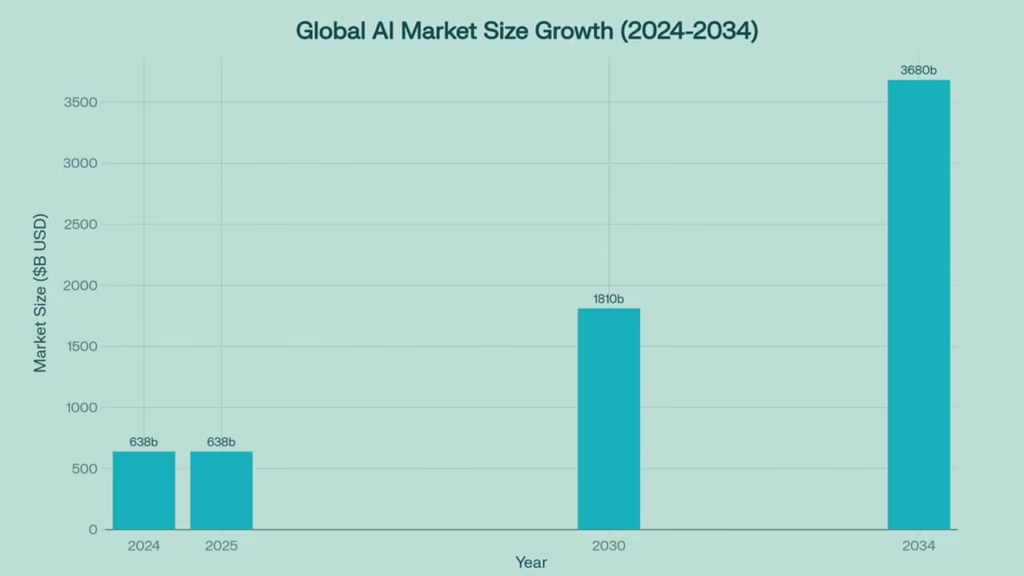
Global AI market size is projected to grow from $638.23 billion in 2024 to $3.68 trillion by 2034, representing massive opportunities for AI-powered businesses
What makes 2025 particularly exciting for digital entrepreneurs is the convergence of powerful AI tools with accessible no-code platforms, making it possible for non-technical founders to build sophisticated, profitable businesses. Whether you’re exploring AI-powered service solutions, diving into the creator economy with virtual influencers, or developing specialized tools that solve niche problems, the barriers to entry have never been lower while the potential rewards have never been higher.
How AI Is Opening Entirely New Markets

The transformative power of artificial intelligence extends far beyond automating existing processes—it’s creating entirely new categories of business opportunities that simply didn’t exist five years ago. Unlike traditional software that required extensive programming knowledge and large development teams, AI tools now enable entrepreneurs to build sophisticated solutions using natural language prompts and intuitive interfaces.
This democratization represents a fundamental shift in how markets emerge and evolve. Where launching a tech startup once required venture capital and technical expertise, today’s AI-powered entrepreneurs can validate ideas, build prototypes, and scale businesses using readily available tools and platforms. The result is what experts call “hyper-personalization at scale”—the ability to deliver individually tailored experiences to thousands or millions of customers simultaneously.
Three key factors are driving this market expansion. First, automation without complexity allows business owners to implement sophisticated AI systems through drag-and-drop interfaces and pre-built integrations. Second, predictive capabilities enable businesses to anticipate customer needs, optimize pricing, and identify market opportunities in real-time. Third, creative augmentation empowers entrepreneurs to produce professional-quality content, designs, and marketing materials without hiring specialized talent.
The impact is measurable: AI-enhanced businesses are experiencing revenue growth rates 45% higher than their traditional counterparts, while operational costs are dropping by an average of 35%. For entrepreneurs, this means the potential to build more profitable businesses faster than ever before, with AI handling the heavy lifting of data analysis, customer service, and content creation.
Perhaps most significantly, AI is enabling what economists call “long tail monetization”—the ability to profitably serve niche markets that were previously too small or expensive to address. A solo entrepreneur can now build specialized tools for specific industries, demographic groups, or use cases, confident that AI will help them scale efficiently as demand grows.
Top AI Online Business Markets and Opportunities
The AI revolution has spawned multiple billion-dollar market categories, each offering unique opportunities for entrepreneurs at different experience levels. Understanding these markets and their potential helps founders identify where their skills and interests align with the greatest commercial opportunities.
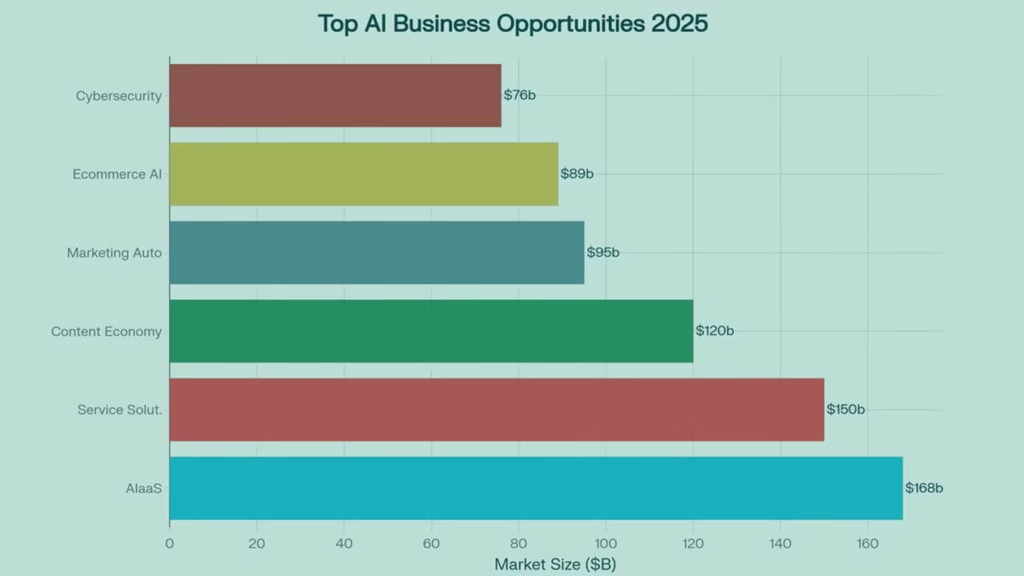
The largest AI business opportunities in 2025, with AIaaS and service solutions leading the market potential for new entrepreneurs
AI-Powered Service Solutions
The service industry, worth over $3 trillion globally, is experiencing unprecedented transformation through AI integration. Traditional service businesses—from consulting and customer support to specialized professional services—are being reimagined through intelligent automation and enhanced human capabilities.
Chatbot and Virtual Assistant Businesses represent one of the most accessible entry points for entrepreneurs. Modern AI chatbots can handle up to 85-90% of customer queries, increasing satisfaction by 5% while improving decision accuracy to over 80%. Companies like Lindy have demonstrated how AI assistants can move beyond simple Q&A to become full workflow automation platforms, handling everything from meeting scheduling to CRM updates.
The opportunity extends far beyond basic customer service. Industry-specific AI assistants are emerging for sectors like healthcare, legal services, and financial advisory, where specialized knowledge and regulatory compliance create higher barriers to entry and correspondingly higher profit margins. A well-designed chatbot service can generate recurring monthly revenue through subscription models, with successful providers reporting average client retention rates above 90%.
Personal AI Services are creating entirely new categories of digital concierge businesses. AI-powered personal shoppers analyze customer preferences, browsing history, and even social media activity to deliver hyper-personalized recommendations. Travel planning assistants can create customized itineraries in minutes, considering budget, interests, and real-time availability. These services typically operate on premium pricing models, as customers value the time savings and personalization.
The beauty of service-based AI businesses lies in their scalability without proportional cost increases. Once developed, an AI assistant can serve hundreds of clients simultaneously, with the primary ongoing costs being API usage and customer acquisition rather than hourly labor.
AI Content & Creator Economies
The content creation market has exploded with AI enablement, growing to an estimated $120 billion opportunity as businesses and individuals seek to produce professional-quality material at unprecedented speed and scale.
AI-Generated Content Agencies are disrupting traditional creative services by offering faster turnaround times and lower costs while maintaining high quality standards. Tools like ChatGPT, Claude, and specialized platforms enable agencies to produce blog posts, social media content, product descriptions, and marketing copy in minutes rather than hours. Successful agencies report being able to serve 5-10 times more clients than traditional content teams while maintaining profit margins above 60%.
The key to success in this space isn’t just using AI tools—it’s developing efficient workflows that combine AI generation with human oversight and brand voice consistency. Agencies like Content Whale have built systematic approaches that leverage AI for initial content creation while employing human editors for refinement and quality assurance.
Virtual Influencers and AI-Powered Digital Personalities represent perhaps the most innovative development in the creator economy. Virtual influencers like Lil Miquela earn over $10 million annually from brand partnerships, while newer entrants are finding success in specialized niches. The appeal for brands is significant: virtual influencers offer complete creative control, never have scheduling conflicts, and can maintain consistent messaging across campaigns.
Creating a virtual influencer requires investment in design and AI technology, but the long-term revenue potential is substantial. Virtual influencers can work 24/7, engage with audiences across multiple languages, and pivot their personality or appearance for different campaigns without the constraints that affect human creators. Early market data shows 58% of consumers follow at least one virtual influencer, with 35% having made purchases based on virtual influencer recommendations.
The podcasting and video content space is also being transformed through AI-powered audio generation, voice cloning, and automated editing tools. Entrepreneurs are building services that can transform written content into professional-quality podcasts or create synthetic voice-overs for video content in multiple languages and styles.
AI Tools as a Service (AIaaS)
The AI-as-a-Service market is projected to reach $168 billion by 2029, representing the largest single opportunity category for entrepreneurs. This market serves businesses that want AI capabilities without building internal AI teams or infrastructure.
Low-Code/No-Code AI Platforms are democratizing AI development, allowing entrepreneurs to build sophisticated applications without traditional programming skills. Platforms like Bubble, combined with AI APIs, enable founders to create everything from customer analytics dashboards to automated marketing systems. The key advantage is speed to market—entrepreneurs can build and test AI-powered solutions in weeks rather than months.
Successful no-code AI businesses often focus on solving specific industry problems. For example, AI-powered inventory management tools for small retailers, automated social media scheduling with content generation for local businesses, or predictive analytics dashboards for e-commerce stores. The subscription model works particularly well in this space, with customers paying monthly fees for ongoing AI capabilities.
Self-Serve AI Marketing and Analytics Tools represent another high-growth segment. Small and medium businesses want access to the same AI-powered insights that large corporations use, but through simplified interfaces and affordable pricing. Tools that provide automated SEO optimization, social media performance analysis, or customer behavior prediction can command premium pricing while serving thousands of small business customers.
The micro-SaaS approach—building very specific AI tools that solve narrow problems—has proven particularly effective. Examples include AI-powered A/B testing for email subject lines, automated competitor price monitoring, or AI-generated product descriptions for e-commerce stores. These focused solutions often achieve faster product-market fit and face less competition than broader platforms.
Niche Data, Security, and Compliance Markets
As AI adoption accelerates, businesses increasingly need specialized services to manage data quality, ensure security, and maintain compliance with evolving regulations. This creates significant opportunities for entrepreneurs who understand both AI capabilities and industry-specific requirements.
AI Cybersecurity Services represent a rapidly growing market as traditional security measures prove inadequate against AI-powered threats. AI-driven security solutions can analyze network traffic patterns, detect anomalies in user behavior, and respond to threats in real-time with accuracy rates exceeding 90%. For entrepreneurs, this market offers both high-value contracts and recurring revenue through managed security services.
The opportunity extends beyond large enterprises. Small and medium businesses are increasingly targets for sophisticated cyber attacks but lack the resources for comprehensive security teams. AI-powered security services that can monitor, detect, and respond to threats automatically are finding strong demand at accessible price points.
Fraud Detection and Prevention Services leverage AI’s pattern recognition capabilities to identify suspicious activities across various industries. Financial services, e-commerce, and healthcare organizations are particularly interested in AI systems that can detect fraud in real-time while minimizing false positives. Successful implementations report fraud detection accuracy rates above 99% while reducing manual review workloads by up to 80%.
AI Compliance and Audit Services are emerging as regulations around AI use become more stringent. Businesses need help ensuring their AI systems operate fairly, transparently, and in compliance with industry regulations. This creates opportunities for entrepreneurs with both AI expertise and regulatory knowledge to build consulting practices and automated compliance monitoring tools.
Ultra-Personalization Markets in E-commerce & Marketing
The e-commerce personalization market is experiencing explosive growth as businesses recognize that personalized experiences drive significantly higher conversion rates and customer lifetime value.
Hyper-Personalized E-commerce Solutions go far beyond basic product recommendations. AI systems can now analyze customer behavior patterns, predict future needs, and dynamically adjust entire shopping experiences in real-time. This includes personalized pricing, customized product displays, and tailored marketing messages that adapt based on individual customer journeys.
The opportunity for entrepreneurs lies in building specialized personalization tools for specific e-commerce platforms or industries. For example, AI-powered size recommendation engines for fashion retailers, personalized nutrition product suggestions based on health data, or dynamic pricing optimization for seasonal businesses. These solutions typically operate through integration with existing e-commerce platforms, making them accessible to merchants without technical expertise.
Dynamic Pricing and Demand Forecasting tools represent another significant opportunity. AI systems can analyze competitor pricing, inventory levels, customer behavior, and market trends to optimize pricing strategies automatically. Successful implementations report revenue increases of 15-25% through better pricing optimization alone.
The marketing automation space is being revolutionized through AI-powered content generation, audience segmentation, and campaign optimization. Tools that can automatically generate personalized email campaigns, create targeted social media content, or optimize ad spending across platforms are finding strong demand among businesses looking to improve marketing ROI while reducing manual workload.
Case Studies and Real Examples (2025)

Understanding how entrepreneurs are successfully building AI-powered businesses provides valuable insights into market opportunities and implementation strategies. These real-world examples demonstrate that success comes not from having the most advanced technology, but from identifying genuine market needs and delivering value through accessible AI solutions.
Virtual Influencer Startup Success
The virtual influencer space has produced several notable success stories that illustrate the commercial potential of AI-powered digital personalities. Lil Miquela, one of the pioneering virtual influencers, reportedly earns over $10 million annually through brand partnerships with luxury fashion brands like Chanel and Givenchy. What makes this particularly interesting for entrepreneurs is that Lil Miquela was created by a small startup team, not a major technology corporation.
More recently, Lu do Magalu, a virtual influencer created for Brazilian retailer Magazine Luiza, has generated over $16.2 million in annual earnings while serving as a brand ambassador and customer service representative. The key insight for entrepreneurs is that virtual influencers don’t need to be generic—they can be designed for specific brands, demographics, or market niches.

Illustration of a virtual influencer interacting through a laptop, symbolizing digital avatars and social media marketing engagement
A particularly innovative example is bee_nfluencer, a virtual bee influencer from France that combines influencer marketing with environmental activism. This demonstrates how entrepreneurs can create virtual personalities around specific causes or missions, appealing to increasingly values-conscious consumers while building sustainable business models.
The success factors common to these virtual influencer businesses include consistent content creation, authentic personality development, and strategic brand partnerships. Entrepreneurs entering this space don’t need to compete directly with established virtual influencers—instead, they can identify underserved niches or create industry-specific virtual personalities.
AI-Driven E-commerce Growth Stories
Several e-commerce businesses have achieved remarkable growth by implementing AI-powered personalization and automation strategies. Amazon’s recommendation engine, which uses AI to analyze customer behavior and suggest products, generates an estimated $1 billion annually in additional revenue. While Amazon‘s scale is unique, the underlying principles are accessible to smaller businesses through modern AI tools.
A more relatable example is how Sephora uses AI to offer personalized beauty recommendations based on customer selfies and purchase history. Their AI tools can analyze facial features to recommend makeup shades and suggest products based on skin type and beauty goals. This approach has significantly improved customer satisfaction and increased average order values.
Smaller e-commerce businesses are finding success with AI-powered inventory management and demand forecasting. One micro-SaaS example, CustomerPing, automatically scans social media and online communities to identify potential customers mentioning relevant keywords, enabling businesses to engage with prospects at the optimal moment. This approach has helped small businesses increase their lead generation by 40-60% while reducing customer acquisition costs.
The pattern across successful AI-powered e-commerce implementations is clear: businesses that use AI to solve specific customer problems—rather than implementing AI for its own sake—see the strongest results. This creates opportunities for entrepreneurs to build focused AI tools that address particular pain points in the e-commerce journey.
Non-Technical Founders Leveraging AI Tools
One of the most encouraging trends in AI entrepreneurship is the success of non-technical founders who use readily available AI tools to build profitable businesses. These examples demonstrate that success in AI-powered business isn’t about coding ability—it’s about identifying market needs and creatively applying available tools.
SketchLogo AI represents an excellent example of this approach. The platform allows users to upload hand-drawn sketches and automatically converts them into professional logos using AI image enhancement. In just four months, the company reached $31,000 in monthly recurring revenue by solving a specific problem: small businesses need professional logos but can’t afford custom design services.
The founder didn’t build the underlying AI technology from scratch—instead, they combined existing AI image processing capabilities with a user-friendly interface and focused marketing to a specific audience. The business model is straightforward: customers pay $19 per logo or subscribe for unlimited designs.
Another inspiring example is GrowthPanels, which reached $2,000 in monthly recurring revenue within two months by creating an AI-powered system that rewards customer actions with automatic discounts. The founders identified that SaaS businesses struggle with customer engagement and built a simple tool that integrates with existing platforms to automatically apply rewards when customers complete desired actions like referrals or onboarding steps.
These success stories share common characteristics: they solve specific problems, use existing AI capabilities creatively, and focus on clear value propositions rather than technical complexity. For aspiring entrepreneurs, this demonstrates that success in AI business is more about market insight and execution than technical expertise.
The key lesson from these examples is that AI tools have become sufficiently accessible that entrepreneurs can focus on business strategy, customer needs, and market execution rather than underlying technology development. This democratization of AI capabilities means the competitive advantage comes from understanding customer problems and delivering value, not from having the most advanced AI algorithms.
Trends & What’s Next

The AI business landscape is evolving at unprecedented speed, with several key trends shaping opportunities for entrepreneurs in 2025 and beyond. Understanding these trends helps founders position their businesses for long-term success and identify emerging market opportunities before they become saturated.
Market Growth and Investment Patterns
The investment landscape in AI continues to accelerate, with nearly 50% of all U.S. startup funding in 2024—approximately $97 billion—going to AI-related companies. This represents a fundamental shift in how venture capital views AI from a experimental technology to a core business infrastructure requirement. For entrepreneurs, this means access to funding for AI-powered businesses has never been better, but it also signals that competition will intensify rapidly.
AI adoption among enterprises has jumped dramatically, from 55% in 2023 to 72% in 2024. This enterprise adoption creates immediate opportunities for B2B AI services, as companies need help implementing, managing, and optimizing AI systems. The consulting and implementation services market alone is projected to be worth tens of billions of dollars as businesses seek expertise in AI strategy and deployment.
Particularly significant for entrepreneurs is the growth in AI-as-a-Service spending. Global AI investments are projected to reach $200 billion in 2025, with a substantial portion going toward cloud-based AI services that smaller businesses can access without large upfront investments. This trend democratizes access to sophisticated AI capabilities and creates opportunities for entrepreneurs to build services on top of these platforms.
Emerging Technologies and Capabilities
Multimodal AI is becoming increasingly sophisticated, processing text, images, audio, and video simultaneously to provide more contextual and accurate responses. For entrepreneurs, this opens opportunities to build applications that understand and respond to multiple forms of input—imagine customer service bots that can analyze product photos, read text descriptions, and respond with visual solutions.
AI Agents are evolving beyond simple chatbots to become autonomous systems capable of managing complex workflows and making decisions. By 2028, an estimated 33% of enterprise software applications will incorporate agentic AI. This creates opportunities for entrepreneurs to build specialized AI agents for specific industries or business functions—from AI-powered project managers to automated financial analysts.
Edge AI processing is becoming more powerful and affordable, enabling AI applications to run directly on local devices rather than requiring cloud connectivity. This trend opens opportunities for entrepreneurs to build AI solutions that work in environments with limited connectivity or heightened privacy requirements, such as healthcare, manufacturing, or remote service applications.
Industry-Specific AI Adoption
Healthcare organizations are leading AI adoption, with 60% having integrated AI solutions into their operations. The healthcare AI market presents significant opportunities for entrepreneurs who understand regulatory requirements and can build compliant solutions for patient care, administrative tasks, or clinical decision support.
The financial services sector is experiencing rapid AI transformation, with applications in fraud detection, algorithmic trading, and customer service showing measurable ROI. AI in banking alone has the potential to create up to $1 trillion in annual value. For entrepreneurs, this represents opportunities in fintech applications, compliance tools, and automated financial advisory services.
Manufacturing is embracing AI for quality control, predictive maintenance, and supply chain optimization. Over 57% of automakers plan to deploy collaborative robots powered by AI, while 50% of manufacturers use AI-powered vision systems for quality control. This industrial AI market offers opportunities for entrepreneurs with domain expertise in specific manufacturing processes.
Regulatory and Ethical Considerations
The regulatory environment around AI is evolving rapidly, with new frameworks emerging for AI safety, transparency, and accountability. The new U.S. administration is expected to shift toward more industry self-governance, creating space for innovation while requiring businesses to implement responsible AI practices.
For entrepreneurs, understanding and building compliance capabilities into AI products from the beginning provides a competitive advantage. Businesses that can demonstrate ethical AI practices, data privacy protection, and algorithmic transparency will have stronger market positions as regulations become more stringent.
Privacy-focused AI solutions are gaining traction as consumers become more aware of data usage. Entrepreneurs who can build AI applications that provide personalization without compromising user privacy—through techniques like federated learning or on-device processing—will find growing demand for their solutions.
Democratization and Accessibility Trends
No-code and low-code AI platforms are becoming increasingly sophisticated, enabling entrepreneurs without technical backgrounds to build complex AI applications. This trend is accelerating the pace of AI business creation and reducing barriers to entry across industries.
The cost of AI development continues to decline as cloud providers compete and open-source tools improve. This makes it economically feasible for entrepreneurs to experiment with AI applications in niche markets that wouldn’t have been viable just a few years ago.
AI education and training resources are proliferating, with platforms like Google offering free AI courses and certification programs. This educational infrastructure is creating a larger pool of AI-literate entrepreneurs and employees, further accelerating market development.
The convergence of these trends suggests that 2025 will be a pivotal year for AI entrepreneurship. The combination of increased investment, improving technology accessibility, growing enterprise adoption, and evolving regulatory frameworks creates an environment where well-positioned AI businesses can achieve rapid growth and significant market impact.
How to Get Started and Tap New AI Markets

Success in AI-powered business doesn’t require a computer science degree or massive startup capital—it requires a systematic approach to identifying opportunities, validating ideas, and building solutions that solve real problems. The following framework has been tested by hundreds of successful AI entrepreneurs and provides a clear path from idea to profitable business.
Beginner Framework: From Idea to Launch
Step 1: Spot Market Gaps Through AI-Powered Research
Begin by using AI tools to identify underserved markets and pain points that existing solutions aren’t adequately addressing. Tools like ChatGPT, Perplexity, and industry-specific AI research assistants can help you analyze market trends, customer complaints, and competitive landscapes in minutes rather than weeks.
Focus on problems you understand personally or through professional experience. The most successful AI entrepreneurs often start by solving problems they’ve encountered in their own work or industries. Use AI to validate that these problems exist at scale and identify the specific demographics most affected by them.
CustomerPing provides an excellent model for this approach—the platform continuously scans online conversations to identify business opportunities where AI solutions could provide value. You can replicate this manually by using AI tools to analyze social media conversations, industry forums, and customer reviews to identify recurring pain points.
Step 2: Pick AI Tools for Rapid Prototyping
Rather than building AI algorithms from scratch, successful entrepreneurs combine existing AI capabilities in creative ways to solve specific problems. The key is selecting tools that allow for rapid experimentation and iteration.
For content-based businesses, start with generative AI platforms like ChatGPT, Claude, or Jasper combined with design tools like Canva or Midjourney. For data analysis applications, consider no-code platforms like Bubble combined with AI APIs from OpenAI, Anthropic, or Google.
The goal at this stage isn’t to build perfect solutions—it’s to create minimum viable products (MVPs) that demonstrate value to potential customers. Many successful AI businesses started as simple combinations of existing tools that solved specific problems better than manual alternatives.
Step 3: Test Fast and Iterate Based on Real Feedback
AI tools excel at helping you rapidly test and refine business ideas. Use AI-powered survey tools, chatbots, and analytics platforms to gather customer feedback quickly and identify the most promising directions for development.
ValidatorAI and similar platforms can provide structured feedback on business concepts within minutes, helping you identify potential challenges and opportunities before investing significant time or resources. The key is to treat these AI insights as starting points for human validation rather than definitive answers.
Build feedback loops into your business model from the beginning. Use AI chatbots to engage with early customers, AI analytics to track user behavior, and AI-powered A/B testing to optimize your offering continuously. This approach allows you to iterate much faster than traditional business development cycles.
Recommended AI Tools and Platforms for Beginners
Content Creation and Marketing
- HubSpot’s AI Content Assistant: Generates marketing emails, blog posts, and social media content with built-in analytics and optimization
- Canva AI: Creates professional designs, presentations, and marketing materials through simple text prompts
- Jasper or Copy.ai: Produces high-quality written content optimized for specific audiences and purposes
Business Development and Analytics
- Bubble + AI Plugins: Build sophisticated web applications without coding, with AI capabilities integrated through APIs
- Make (formerly Integromat): Automate workflows between different business tools using visual, drag-and-drop interfaces
- Akkio: Provides predictive analytics and data insights for marketing and sales teams without requiring data science expertise
Customer Service and Engagement
- Intercom or Zendesk AI: Deploy intelligent chatbots that can handle customer inquiries, schedule appointments, and qualify leads
- FastBots.ai or ChatBot: Create custom AI assistants trained on your business data for customer support and lead generation
Validation and Research
- ValidatorAI: Get structured feedback on business ideas and market opportunities
- Perplexity or Claude: Conduct market research, competitive analysis, and customer persona development
The key to success with these tools is starting simple and scaling complexity as you gain experience and customer feedback. Many successful entrepreneurs begin with one or two tools and gradually build more sophisticated systems as their businesses grow.
Validation Framework: Proving Your AI Business Idea
Market Demand Validation
Use AI tools to analyze search trends, social media conversations, and competitor performance to validate that significant demand exists for your proposed solution. Tools like Google Trends combined with AI analysis can reveal whether interest in your target problem is growing or declining.
Survey potential customers using AI-powered tools that can analyze responses for sentiment and identify the most common pain points. This approach provides quantitative validation much faster than traditional market research methods.
Technical Feasibility Assessment
Before committing to a specific technical approach, use AI platforms to prototype your core functionality and test whether existing tools can deliver the results your customers need. This prevents over-engineering and helps you identify the simplest path to a working solution.
Many successful AI businesses discover that their initial technical assumptions were incorrect, but because they tested quickly with existing tools, they could pivot without losing months of development time.
Financial Model Validation
Use AI-powered financial modeling tools to test different pricing strategies, customer acquisition approaches, and growth scenarios. These tools can help you understand unit economics and identify the key metrics that will drive profitability.
Focus particularly on customer lifetime value (LTV) to customer acquisition cost (CAC) ratios, as AI businesses often have different economics than traditional software companies due to ongoing AI service costs.
Standing Out with Human Touch Alongside Automation
While AI provides powerful capabilities, the most successful AI businesses combine automation with genuine human insight and connection. This hybrid approach creates competitive advantages that pure AI solutions cannot match.
Personalized Implementation and Support
Offer personalized onboarding, training, and support that helps customers get maximum value from your AI solutions. Many AI tools are powerful but complex—providing human guidance in implementing and optimizing these tools creates significant customer value.
Industry Expertise and Context
Combine AI capabilities with deep understanding of specific industries or customer segments. AI tools are becoming commoditized, but AI tools applied by experts who understand particular business contexts remain highly valuable and defensible.
Ethical AI Practices
Build transparency, explainability, and ethical considerations into your AI solutions from the beginning. As AI regulations evolve, businesses that can demonstrate responsible AI practices will have significant competitive advantages.
The entrepreneurs who succeed in AI-powered businesses understand that AI is a powerful tool for solving human problems, not a replacement for human insight, creativity, and connection. The key is finding the right balance between automation and human value that creates defensible, profitable businesses while genuinely serving customer needs.
Risks and Pitfalls to Watch Out For

While AI creates unprecedented opportunities for entrepreneurs, it also presents unique challenges and risks that require careful consideration and proactive management. Understanding these pitfalls helps founders build more resilient businesses and avoid common mistakes that can derail promising AI ventures.
AI-Generated Content Quality and Authenticity Challenges
AI content generation, while powerful and cost-effective, presents several quality and authenticity concerns that entrepreneurs must address proactively. AI-generated text can contain factual errors, exhibit biases present in training data, or produce content that lacks the nuanced understanding that human experts provide.
The most significant risk is over-reliance on AI without proper human oversight. Content agencies that publish AI-generated material without thorough review risk damaging their reputation and client relationships when errors or inappropriate content reaches audiences. Successful AI content businesses implement systematic review processes where human editors verify facts, ensure brand voice consistency, and add industry-specific insights that AI cannot provide.
Authenticity concerns are particularly relevant for AI-powered marketing and social media content. Audiences are becoming increasingly sophisticated at detecting AI-generated content, and platforms like LinkedIn and Instagram are developing policies around AI-generated material disclosure. Entrepreneurs building content-focused AI businesses must develop transparent policies about AI usage and find ways to maintain authentic brand voices.
To mitigate these risks, implement multi-layered quality control processes. Use AI for initial content generation, but always have human experts review and refine the output. Develop clear guidelines about when and how to disclose AI usage to maintain trust with customers and end users.
Transparency, Compliance, and Data Privacy Requirements
The regulatory landscape around AI is evolving rapidly, with new requirements emerging for algorithmic transparency, data usage disclosure, and user privacy protection. Entrepreneurs building AI-powered businesses must stay ahead of these regulatory changes or risk significant legal and financial consequences.
Data privacy represents a particular challenge for AI businesses, as AI systems often require access to large amounts of customer data to function effectively. The General Data Protection Regulation (GDPR) in Europe and similar laws emerging in other jurisdictions require explicit consent for data processing and give users rights to understand how their data is used.
AI transparency requirements are becoming more stringent, particularly for businesses serving regulated industries like finance, healthcare, or employment. Companies must be able to explain how their AI systems make decisions, what data influences those decisions, and how biases are identified and mitigated.
Compliance costs can be significant for small AI businesses. Consider partnering with legal experts who understand AI regulations, and build compliance capabilities into your products from the beginning rather than retrofitting them later. This approach turns compliance from a burden into a competitive advantage, as customers increasingly prefer AI providers who can demonstrate responsible practices.
Document your AI development processes, data usage policies, and decision-making algorithms thoroughly. This documentation proves invaluable when responding to regulatory inquiries, customer audits, or partnership due diligence processes.
The “Me-Too” Problem: Why Differentiation Matters
The accessibility of AI tools has created a proliferation of similar businesses targeting the same opportunities. Generic AI chatbot services, basic content generation agencies, and simple automation tools face intense price competition and struggle to build sustainable differentiation.
The “me-too” problem is particularly acute in horizontal AI markets where multiple entrepreneurs build similar solutions for broad audiences. Success in these crowded spaces requires either exceptional execution or pivoting to more specialized niches where domain expertise creates competitive moats.
Successful AI entrepreneurs avoid this trap by focusing on specific industries, customer segments, or use cases where they can develop deep expertise and defensible advantages. For example, rather than building a general AI writing tool, focus on AI-powered legal document generation, technical manual creation, or industry-specific content that requires specialized knowledge.
Build network effects and customer lock-in into your business model where possible. AI businesses that become more valuable as more customers use them—through improved algorithms, better training data, or community features—create stronger competitive positions than those offering commoditized AI capabilities.
Consider vertical integration strategies that combine multiple AI capabilities to solve complete customer problems rather than offering point solutions. Customers prefer working with fewer vendors, and integrated solutions are harder for competitors to replicate.
Technical Dependencies and Vendor Lock-in Risks
Most AI entrepreneurs build their businesses on top of existing AI platforms like OpenAI’s GPT models, Google’s AI services, or Anthropic’s Claude. While this approach enables rapid development and reduces upfront costs, it also creates dependencies that can threaten business sustainability.
API pricing changes represent a significant risk for AI businesses built on third-party platforms. As AI providers optimize their pricing models, businesses that haven’t designed their economics carefully may find their unit costs increasing faster than their ability to raise prices to customers.
Service availability and performance issues with underlying AI platforms directly impact customer experiences and business operations. When OpenAI experiences outages or performance degradations, all businesses built on their APIs suffer similar problems, often with no recourse or compensation for lost business.
Mitigate these risks by designing vendor diversity into your architecture where possible. Use multiple AI providers for different functions, and maintain the technical capability to switch providers if necessary. While this adds complexity, it reduces single points of failure that could threaten your business.
Build direct customer relationships and defensible business logic that doesn’t depend entirely on specific AI capabilities. The most resilient AI businesses create value through data, domain expertise, customer relationships, and workflow integration rather than relying solely on AI algorithm performance.
Consider the long-term sustainability of your chosen AI platforms. Providers with strong financial backing and clear business models are likely to be more stable partners than those with uncertain funding or business viability.
Market Saturation and Timing Risks
AI markets are developing extremely rapidly, with new entrants launching daily and competitive dynamics shifting quickly. Markets that appear promising today may become saturated within months as barriers to entry remain low for many AI applications.
The timing of market entry becomes crucial in fast-moving AI markets. Early entrants can establish customer relationships and market presence before competition intensifies, while late entrants may find established players with significant advantages in customer acquisition costs, brand recognition, and product development resources.
However, being too early can also be problematic. Some AI capabilities that seem promising today may not reach sufficient maturity or cost-effectiveness to support viable businesses. Entrepreneurs who build businesses around emerging AI capabilities risk investing time and resources in technologies that don’t develop as expected.
Monitor competitive landscapes continuously and maintain flexibility to pivot or expand into adjacent markets as opportunities evolve. The most successful AI entrepreneurs remain alert to changing market conditions and adjust their strategies accordingly rather than rigidly pursuing initial plans.
Focus on building businesses around fundamental customer needs that will persist even as AI capabilities evolve. Companies that solve enduring problems using AI as a tool are more likely to remain viable than those built around specific AI features or capabilities.
Understanding and actively managing these risks doesn’t eliminate them, but it significantly improves the probability of building a sustainable, profitable AI-powered business. The key is maintaining realistic expectations about challenges while taking advantage of the unprecedented opportunities that AI technologies create for innovative entrepreneurs.
Summary & FAQ
The artificial intelligence revolution has created an unprecedented opportunity landscape for digital entrepreneurs in 2025. With the global AI market projected to grow from $638 billion to nearly $3.7 trillion by 2034, and 72% of companies now actively using AI technologies, the foundation for AI-powered business success has never been stronger. The democratization of AI tools means that both technical and non-technical founders can build sophisticated, profitable businesses by combining readily available AI capabilities with market insight and customer focus.
The most significant opportunities exist in AI-powered service solutions, content and creator economies, AI-as-a-Service platforms, and specialized applications in e-commerce personalization and cybersecurity. Success stories from virtual influencers earning millions to micro-SaaS platforms reaching profitability within months demonstrate that the potential for rapid growth and substantial returns is real and accessible.
However, success requires more than just implementing AI technology—it demands systematic market validation, careful attention to quality and compliance requirements, and strategic differentiation in increasingly competitive markets. The entrepreneurs who thrive will be those who use AI to solve genuine problems while maintaining the human insight and connection that creates lasting customer value.
Top 3 Action Steps to Tap These AI Opportunities:
- Start with Market Research Using AI Tools: Use platforms like ChatGPT, ValidatorAI, and Perplexity to identify underserved market needs and validate demand before building solutions. Focus on problems you understand through personal or professional experience.
- Build Your Minimum Viable Product Using Existing Tools: Combine accessible platforms like Bubble, HubSpot, or Canva with AI APIs to create prototypes quickly. Test your core value proposition with real customers before investing in complex development.
- Establish Quality Control and Compliance Processes Early: Implement human oversight for AI-generated content, develop transparent data usage policies, and build regulatory compliance into your business model from the beginning to create sustainable competitive advantages.
Frequently Asked Questions
Do I need to know coding to join this AI business trend?
No, coding knowledge is not required for most AI business opportunities in 2025. The success stories highlighted in this article—from SketchLogo AI generating $31,000 monthly to virtual influencers earning millions—were largely built by entrepreneurs using existing AI tools and platforms rather than developing custom algorithms. No-code platforms like Bubble, automation tools like Make, and AI services like OpenAI’s APIs enable non-technical founders to build sophisticated applications. The competitive advantage comes from understanding customer needs and market dynamics rather than programming skills.
Will AI replace all founders and make human entrepreneurs obsolete?
AI enhances rather than replaces entrepreneurial capabilities. While AI can automate many operational tasks, successful businesses still require human insight for market understanding, creative problem-solving, and building customer relationships. The most successful AI businesses combine automation with human expertise—AI handles repetitive tasks while humans provide strategic direction, quality oversight, and authentic customer connection. The role of entrepreneurs is evolving to focus more on orchestrating AI capabilities and less on manual execution, but human judgment and creativity remain essential.
Are there legal or regulatory issues I should know about when starting an AI business?
Yes, several important legal considerations apply to AI businesses. Data privacy regulations like GDPR require explicit consent for data processing and transparent disclosure of how customer information is used. AI transparency requirements, particularly in regulated industries, may require you to explain how your algorithms make decisions. Content generation businesses must consider intellectual property issues and disclosure requirements for AI-generated material. However, the regulatory environment currently favors industry self-governance over restrictive oversight. Building compliance capabilities into your business model from the beginning creates competitive advantages as regulations evolve.
How much money do I need to start an AI-powered business?
Many successful AI businesses start with minimal upfront capital. Thanks to affordable and accessible AI platforms, no-code tools, and cloud services, you can launch a prototype for under $1,000 or even less. Subscription fees for AI APIs and services typically scale with your usage, so initial costs remain low until you find product-market fit and start acquiring paying customers. Your primary investments will often be time, marketing, and customer validation.
Bootstrapped founders frequently begin by leveraging free tiers of AI services, open-source tools, and tight focus on niche markets to reduce costs. However, growing quickly and serving significant demand will require budget for AI API usage, marketing, and potentially hiring essential human talent for quality control and customer service. Strategic planning on unit economics and pricing early on prevents surprises as your business scales.
Final Thoughts
2025 marks a pivotal moment in online entrepreneurship, where artificial intelligence is not just a tool but a fundamental driver of new online markets and business models. The convergence of AI capabilities, low barriers to entry, and rising enterprise adoption presents unprecedented opportunities for digital entrepreneurs, side hustlers, and small business founders at every experience level.
By focusing on real customer problems, combining AI automation with human creativity and oversight, and staying mindful of ethical and compliance considerations, you can build sustainable AI-powered businesses that transform industries and capture emerging markets. Whether you’re creating AI-powered service solutions, tapping into creator economies, or launching specialized AI-as-a-Service platforms, the time to act is now.
Harness the actionable insights, tools, and frameworks outlined here to explore, validate, and launch your AI business venture. The new era of AI online business markets offers both immense potential and the need for thoughtful execution—embrace it with curiosity, strategy, and a human touch.
This article forms part of our series, “Ultimate Guide to Profitable Online Business Ideas.” By exploring the full series, you’ll gain actionable insights, proven strategies, and in-depth resources to confidently launch and grow a sustainable, profitable online business for years to come.