

Starting a business without validating demand is like building a house without checking if the ground can support it. The statistics tell a sobering story: 42% of startups fail because they create products nobody wants. But here’s the empowering truth—learning how to validate demand makes this entirely preventable with the right validation approach.
Demand validation isn’t just a nice-to-have step; it’s the single most important foundation for any successful business. It’s the difference between spending months building something people will actually pay for versus wasting precious time and money on assumptions. In 2025, with advanced tools and proven methodologies at your fingertips, there’s no excuse for launching blind.
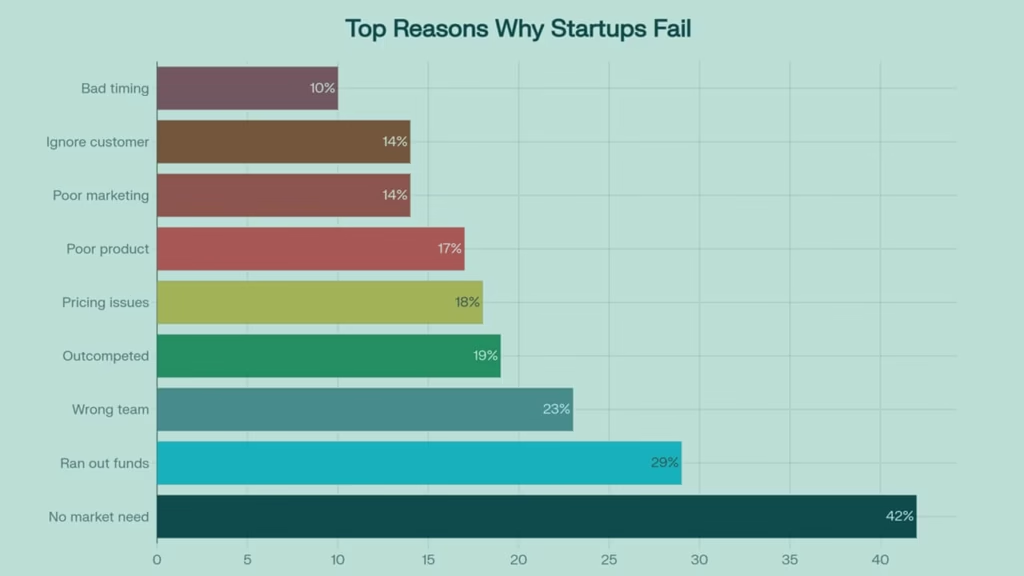
Bar chart showing the primary reasons why startups fail, with “No market need” being the leading cause at 42%
What Is Demand Validation and Why Does It Matter?

Demand validation is the systematic process of confirming that real customers actually want—and will pay for—your product or service before you invest significant time and money building it. Think of it as your business insurance policy against the most common cause of startup failure.
Market validation goes far beyond asking friends if they “like” your idea. It involves gathering hard evidence through customer behavior, search data, pre-orders, and direct feedback from your target market. The goal is simple: prove that strangers will open their wallets for what you’re offering.
The Costly Pitfalls of Skipping Validation
When entrepreneurs skip demand validation, they typically encounter these devastating scenarios:
- Wasted Development Time: Spending 6-12 months building features nobody wants
- Sunk Costs: Investing thousands in development, marketing, and operations with no return
- Disappointing Launches: Launching to crickets instead of eager customers
- Missed Market Opportunities: While you build the wrong thing, competitors capture the real demand
- Emotional and Financial Burnout: The crushing realization that your “brilliant” idea doesn’t solve a real problem
The research is crystal clear: 90% of startups fail overall, with the vast majority failing because they never achieved product-market fit. But startups that conduct thorough validation are significantly more likely to achieve sustainable growth.
Step-By-Step: How to Validate Demand Before Launch
The validation process doesn’t have to be complicated or expensive. Following a systematic approach ensures you gather reliable data to make informed decisions about your business future.
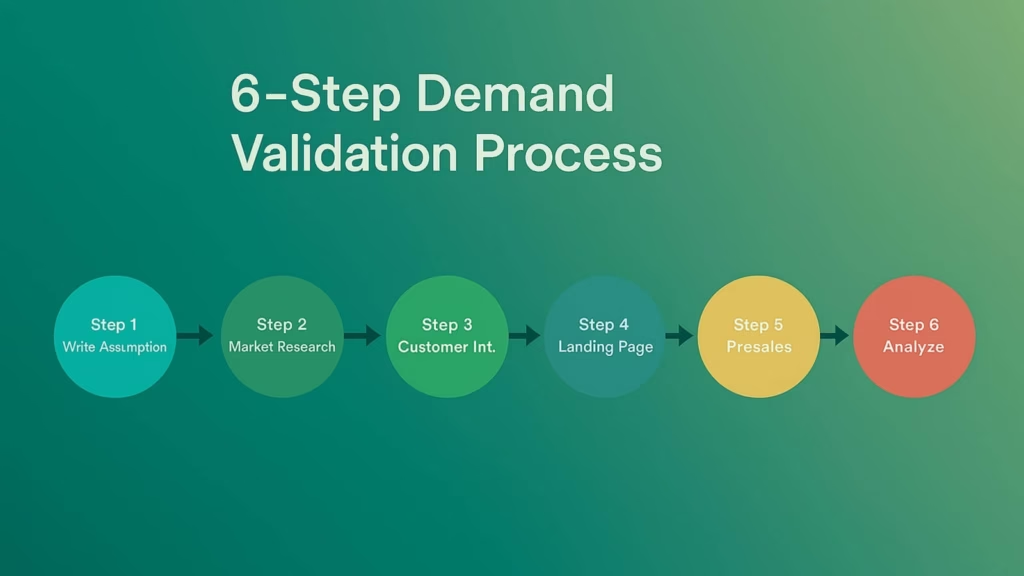
Flowchart showing the complete 6-step demand validation process from initial assumptions to final analysis and iteration
Step 1: Write Down Your Assumptions, Hypotheses & Goals
Before you can validate anything, you need to clearly articulate what you believe to be true about your business idea. This critical first step prevents you from validating in circles and helps focus your research efforts.
Start by documenting these core assumptions:
- Problem Statement: What specific problem are you solving? Write it in 1-2 clear sentences
- Target Customer: Who exactly experiences this problem? Create a detailed customer persona
- Solution Hypothesis: How does your product solve the problem better than existing alternatives?
- Pricing Assumptions: How much will customers pay? What’s your revenue model?
- Market Size: How many people have this problem? Is the market large enough?
Pro Tip: Use frameworks like the Lean Canvas or Problem Statement Template to organize your thoughts systematically. The clearer your assumptions, the better you can test them.
Step 2: Assess Market Size & Existing Demand
Smart validation starts with understanding the landscape you’re entering. This step helps you determine if there’s sufficient demand and opportunity for your product to succeed.
Competitor Analysis: Identify 3-5 direct competitors and analyze their offerings, pricing, and market positioning. If you can’t find any competitors, that’s either a red flag (no market exists) or a massive opportunity.
Search Trend Research: Use Google Trends to validate that people are actively searching for solutions to your problem. Look for:
- Consistent or growing search volume over time
- Related keywords and queries that reveal customer intent
- Seasonal patterns that might affect demand
Market Sizing: Calculate your Total Addressable Market (TAM), Serviceable Available Market (SAM), and Serviceable Obtainable Market (SOM). This helps determine if the opportunity justifies your investment.
Search Volume Analysis: Tools like Google Keyword Planner can reveal monthly search volumes for terms related to your solution. If over 11,500 people search monthly for related terms, that indicates genuine demand.
Step 3: Customer Discovery Interviews & Surveys
This is where validation gets real. You need to talk directly to people who have the problem you’re solving—not just friends and family who want to be supportive.
Interview Structure: Conduct structured one-on-one interviews with 10-15 potential customers. Focus on understanding their problems, current solutions, and frustrations rather than pitching your idea.youtube
Key Questions to Ask:
- “Tell me about the last time you encountered [specific problem]”
- “What do you currently do to solve this problem?”
- “How much time/money does this problem cost you?”
- “What would an ideal solution look like to you?”
- “If I could solve this problem perfectly, what would you pay for it?”
Avoid Leading Questions: Don’t ask “Would you use this product?” Instead, focus on understanding their current behavior and pain points.
Where to Find Interview Candidates:
- Industry-specific Facebook and LinkedIn groups
- Reddit communities related to your market
- Professional associations and forums
- Cold outreach to potential customers
- Referrals from your network
Survey Tools for Scale: Use platforms like Google Forms, SurveyMonkey, or Typeform to gather feedback from larger audiences when interviews aren’t feasible.
Step 4: Test Interest with Landing Pages & MVPs
Now it’s time to test whether people will take action—not just express interest. Creating a simple landing page is one of the most cost-effective ways to validate demand.
Landing Page Testing:
- Create a one-page website describing your solution and its benefits
- Include a clear call-to-action (email signup, pre-order, or waitlist)
- Drive targeted traffic using small-budget ads on Facebook, Google, or LinkedIn
- Success benchmark: A 2%+ conversion rate indicates genuine interest
Minimum Viable Product (MVP) Approach: Build the simplest version of your product that delivers core value. This doesn’t mean a full-featured product—it means the bare minimum that solves the primary problem.
Popular MVP Testing Methods:
- Concierge MVP: Manually deliver your service to early customers
- Smoke Test: Create a fake product page to measure interest before building anything
- Wizard of Oz: Present a working front-end while manually handling the backend processes
Traffic and Conversion Tracking: Use Google Analytics to track visitor behavior, conversion rates, and user engagement. If you can’t achieve cost-effective traffic acquisition, it may indicate market challenges.
Step 5: Pre-sales, Crowdfunding & Paid Experiments
The ultimate validation test is simple: will people pay you money? Pre-sales and crowdfunding campaigns provide the strongest evidence of genuine demand.
Pre-order Strategies:
- Set up payment processing (Stripe, PayPal) to accept real orders
- Offer early-bird pricing or exclusive features for pre-orders
- Be transparent about delivery timelines and development status
- Target: Aim for at least 1% pre-order conversion rate and minimum 10 paying customers
Crowdfunding Platforms: Kickstarter, Indiegogo, and similar platforms let you test market demand while raising development capital. Success here validates both demand and willingness to pay.
Paid Advertising Tests: Run small-budget ads (starting with $50-100) to drive traffic to your landing page or pre-order page. If you can’t acquire customers profitably at small scale, scaling will be extremely difficult.
Email List Building: Build a waitlist of interested prospects. A strong email list with 5%+ conversion rates indicates genuine interest.
Step 6: Analyze, Learn & Iterate
Validation isn’t a one-time event—it’s an ongoing process of learning and refinement. The data you collect should drive clear decisions about next steps.
Key Metrics to Track:
- Conversion Rates: From visitors to email signups to paying customers
- Customer Acquisition Cost (CAC): How much it costs to acquire each customer
- Engagement Metrics: How actively people interact with your content and product
- Feedback Sentiment: Positive vs. negative responses from interviews and surveys
Making the Go/No-Go Decision:
- Green Light: Strong conversion rates, positive feedback, pre-orders from strangers, and cost-effective customer acquisition
- Pivot Required: Lukewarm interest, high acquisition costs, or negative feedback about core value proposition
- Stop: No meaningful engagement, inability to find paying customers, or feedback indicating the problem isn’t worth solving
Iteration Strategies: Use validation feedback to refine your target market, adjust pricing, modify features, or pivot your entire approach. The goal is learning, not being right.
Lean Validation Tools and Tactics for 2025

Modern entrepreneurs have access to powerful tools that make validation faster, cheaper, and more accurate than ever before.
AI-Powered Validation Tools
Fe/male Switch SANDBOX and ValidatorAI: These AI-driven platforms provide structured validation roadmaps and can complete initial market assessment in 2-3 weeks instead of months.
Benefits of AI Validation:
- 3.5x faster validation timelines compared to traditional methods
- Process millions of data points from social media, search trends, and market signals
- Reduce human bias in market research
- Cost-effective alternative to expensive market research firms
Social Media and Community Validation
Reddit Strategy: Post your concept in relevant subreddits (r/startups, r/Entrepreneur, specific industry communities) to get honest feedback from potential customers.
Facebook and LinkedIn Groups: Share your validation surveys and landing pages in targeted professional groups.
Social Media Polls: Use Instagram Stories, Twitter polls, and LinkedIn polls to quickly gauge interest in specific features or concepts.
Advanced Testing Techniques
Smoke Tests: Create convincing landing pages for products that don’t exist yet to measure genuine interest before development.
A/B Testing: Test different value propositions, pricing models, or marketing messages to optimize conversion rates.
Competitor Social Listening: Monitor competitor mentions and customer complaints to identify market gaps and opportunities.
Quick Checklist: How Do You Know Demand Is Real?
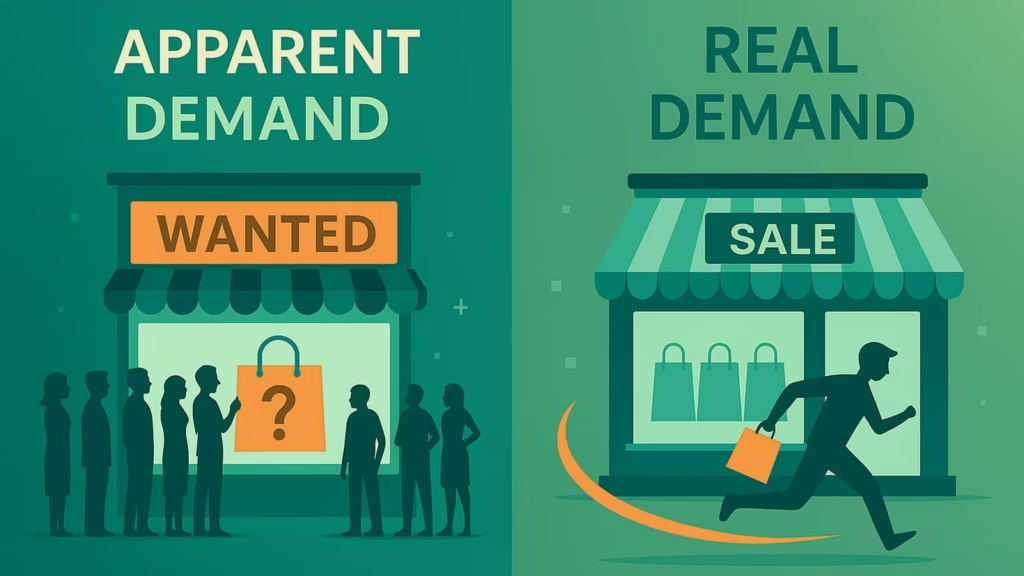
Distinguishing between genuine validation and false positives is crucial for making smart business decisions.
Strong Demand Indicators
Strangers Pay Money: The gold standard—people who don’t know you personally are willing to pay for your solution.
High Pre-order Conversion: 1%+ conversion rate from visitors to paid pre-orders indicates genuine demand.
Organic Growth and Referrals: Customers actively recommend your product without incentives.
Strong Problem Validation: 60%+ of interview participants confirm the problem exists and rate pain severity as 7+ out of 10.
Sustainable Customer Acquisition: You can acquire customers at a cost significantly lower than their lifetime value.
Engagement Metrics: High email open rates, social media engagement, and returning website visitors.
Red Flags to Avoid
Friends and Family Only: If only people who know you personally express interest, it’s not validation—it’s politeness.
Low Conversion Rates: Landing pages with less than 2% conversion typically indicate weak demand.
Heavy Discounting Required: If you need to discount heavily to generate any interest, the value proposition may be weak.
Ignoring Negative Feedback: Dismissing criticism or poor metrics instead of addressing them honestly.
No One Signs Up: If you can’t get email signups or waitlist conversions, paid customers are unlikely.
Common Mistakes and Best Practices
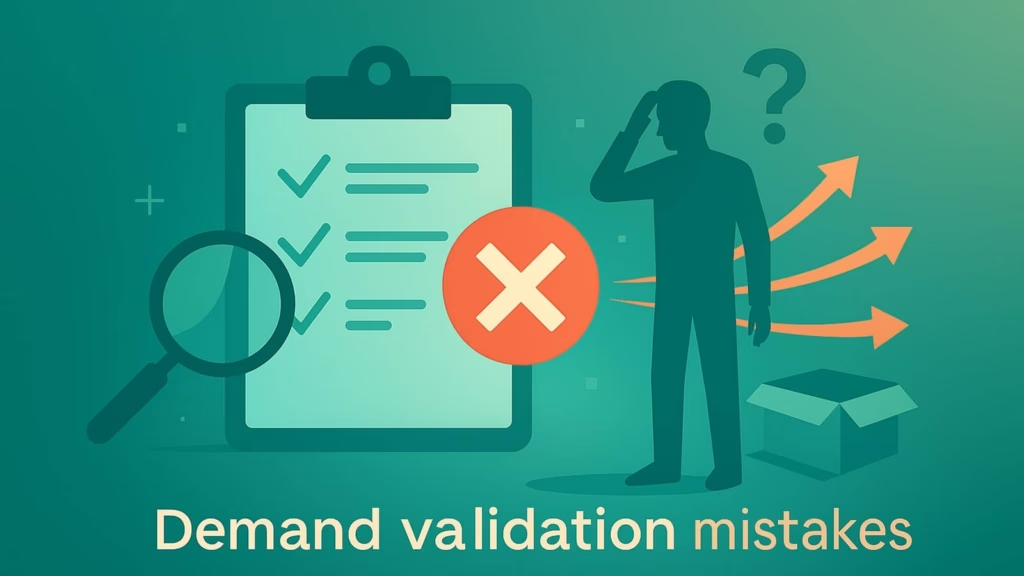
Learning from others’ validation mistakes can save you time, money, and heartache.
Critical Mistakes to Avoid
Falling in Love with Your Idea: Emotional attachment blinds you to market realities. Focus on the problem, not your specific solution.
Asking Leading Questions: Questions like “Would you buy this?” typically yield false positives. Focus on current behavior and pain points.
Skipping Customer Discovery: Relying on assumptions instead of talking to actual customers is the fastest path to failure.
Validating in an Echo Chamber: Only talking to people who think like you or are in your industry.
Overcomplicating Your MVP: Building too many features before validating core value proposition.
Not Defining Success Metrics: Without clear benchmarks, you can’t objectively evaluate validation results.
Validation Best Practices
Focus on Paid Demand: Prioritize metrics that involve money changing hands over vanity metrics like likes and shares.
Seek Honest Criticism: Actively pursue negative feedback—it’s more valuable than praise for improving your offering.
Iterate Rapidly: Make small, fast changes based on feedback rather than major pivots.
Test Assumptions Early and Often: Don’t wait until your product is “ready”—start testing assumptions immediately.
Separate Problem from Solution: Validate that the problem exists before falling in love with your specific solution.
Use Multiple Validation Methods: Combine interviews, surveys, landing pages, and pre-sales for comprehensive validation.
Action Plan & Next Steps

Validation success comes from taking systematic action, not from reading about it. Here’s your immediate action plan:
Week 1-2: Foundation Setting
- Document Your Assumptions: Complete a Lean Canvas outlining your problem, solution, and target customer
- Competitive Research: Identify and analyze 3-5 competitors
- Search Trend Analysis: Use Google Trends to validate search demand for your solution
Week 3-4: Customer Discovery
- Schedule Customer Interviews: Book 10-15 interviews with potential customers using the question framework above
- Validate Pain Points: Confirm that 60%+ of interviewees rate the problem severity as 7+ out of 10
Week 5-6: Demand Testing
- Build Landing Page: Create a simple one-page site with clear value proposition and email capture
- Drive Targeted Traffic: Spend $100-500 on targeted ads to test conversion rates
- Track Metrics: Measure conversion rates, cost per lead, and user engagement
Week 7-8: Commercial Validation
- Test Pre-sales: Offer pre-orders or early access with real payment processing
- Analyze Results: Calculate conversion rates, customer acquisition costs, and gather feedback
- Make Go/No-Go Decision: Based on data, decide to proceed, pivot, or pause
Essential Resources for Deeper Learning
- Market Research Guides: Industry reports and customer interview templates
- MVP Building Resources: No-code tools and rapid prototyping guides
- Customer Interview Scripts: Proven question frameworks and analysis methods
- Landing Page Optimization: Conversion rate optimization and A/B testing strategies
FAQ Section
Can I validate demand without a product?
Absolutely—and you should. Pre-product validation using landing pages, surveys, and pre-orders is often more accurate than post-product feedback. Tools like smoke tests and crowdfunding campaigns let you measure real interest before investing in development.
What’s the quickest way to see if people will pay?
Set up a simple pre-order page with payment processing and drive targeted traffic to it. Even a basic Stripe payment link can test willingness to pay. If you can generate pre-orders from strangers within 2-4 weeks, you’ve validated payment intent.
What if my initial feedback is negative?
Negative feedback is a gift—it prevents expensive mistakes. Analyze the feedback to understand if you need to:
- Target different customers
- Solve a different problem
- Adjust your solution approach
- Pivot to a related but different opportunity
Is it possible to over-validate?
Yes. Analysis paralysis can be as dangerous as under-validation. Set clear validation milestones (e.g., 15 customer interviews, 100 website visitors, 10 pre-orders) and make decisions when you hit them. Perfect certainty doesn’t exist in business.
Summary & Motivational Close
Demand validation isn’t optional—it’s the cornerstone of every successful business in 2025. The entrepreneurs who win are those who validate fast, learn quickly, and adapt based on real market feedback.
The tools and techniques outlined in this guide can help you validate your idea in days or weeks, not months. From AI-powered market research to simple landing page tests, you now have a proven roadmap to avoid the 42% of startups that fail due to lack of market need.
Your validation journey starts this week. Don’t let another month pass building assumptions instead of testing realities. Pick one validation method from this guide and execute it within the next 7 days. Your future self—and your bank account—will thank you.
The most successful entrepreneurs aren’t those with perfect ideas; they’re those who validate imperfect ideas and improve them based on real customer feedback. Start validating today, and join the 10% of startups that actually succeed.
Ready to share your validation experience or ask questions? The entrepreneurial community thrives on shared learning—your insights could help the next founder avoid costly mistakes and achieve faster success.
This article forms part of our series, “How to Choose the Right Business Model for You.” For further guidance on selecting a business model that fits your strengths and aspirations, be sure to explore the full series for actionable insights and expert advice.