

Starting a side hustle without proper validation is like building a house without checking if the foundation is solid—you might invest months of effort and hundreds of dollars only to discover nobody wants what you’re offering. Research shows that 90% of startups fail, primarily due to lack of proper market validation. The good news? You can dramatically increase your chances of success by learning how to validate a side hustle idea before you fully commit.
This comprehensive guide will walk you through proven, low-cost methods to test your side hustle concept, collect meaningful feedback, and make confident decisions about moving forward. Whether you’re considering freelance services, digital products, or physical goods, these validation techniques will save you time, money, and heartache while setting you up for sustainable success.
Why Validate a Side Hustle Idea?

The High Cost of Skipping Validation
Too many aspiring entrepreneurs jump straight into execution mode, driven by excitement about their “brilliant” idea. This approach often leads to devastating consequences: wasted time building products nobody wants, depleted savings on inventory that won’t sell, and the crushing disappointment of a failed venture.
Consider this sobering reality: 34% of startups fail specifically due to lack of product-market fit—they built something the market didn’t need or wasn’t willing to pay for. These failures aren’t due to poor execution or bad luck; they’re the predictable result of skipping the validation phase.
The Power of Validation
Smart entrepreneurs understand that validation isn’t just about avoiding failure—it’s about maximizing success. Companies that validate their ideas before launch see dramatically higher success rates. Validation helps you:
- Minimize financial risk by testing assumptions before major investments
- Understand your customers deeply so you can serve them better
- Identify the most profitable opportunities among multiple ideas
- Build confidence in your business model before quitting your day job
- Attract early customers who are genuinely excited about your solution
Validation isn’t about seeking permission or waiting for perfect certainty. It’s about gathering enough evidence to make informed decisions about where to invest your precious time and resources.
Quick Market Research: Your Foundation for Success

Understanding Market Research for Side Hustles
Market research for side hustles doesn’t require expensive consultants or complex studies. It’s about answering three fundamental questions: Is there demand for what you want to offer? Who exactly wants it? How are they currently solving this problem?
Start with Google and keyword research tools. Search for terms related to your idea and pay attention to search volume trends. Tools like Google Trends, Ubersuggest, and Answer the Public can reveal what people are actively searching for and how interest has changed over time.
Mining Online Communities for Insights
Reddit, Facebook groups, and industry forums are goldmines of customer insights. Join communities where your target customers hang out and observe their conversations. What problems do they complain about repeatedly? What solutions do they recommend to each other? What gaps exist in current offerings?
For example, if you’re considering a meal planning service for busy parents, spend time in parenting subreddits, Facebook groups for working mothers, and nutrition forums. Look for recurring themes in their discussions about meal preparation challenges.
Competitive Analysis Made Simple
Don’t fear competition—embrace it as validation that a market exists. The presence of competitors often indicates market demand rather than saturation. Analyze your competitors by examining:
- Their pricing strategies and value propositions
- Customer reviews highlighting what people love and hate
- Social media engagement to gauge customer satisfaction
- Content marketing to understand how they attract customers
- Product features to identify gaps you could fill
Use tools like Similarweb to understand competitor website traffic and engagement patterns. This data helps you identify whether the market is growing or shrinking and where opportunities might exist.
Identifying Customer Pain Points
The most successful side hustles solve genuine problems that people actively experience. Look for pain points in several places:
- Online reviews of existing products or services in your space
- Social media complaints about current solutions
- Forum discussions where people ask for help or advice
- Your own experience and those of people in your network
Document these pain points specifically. Instead of noting “people want better customer service,” write “customers wait 2+ hours for email responses and can’t reach anyone by phone.” Specific pain points lead to specific solutions.
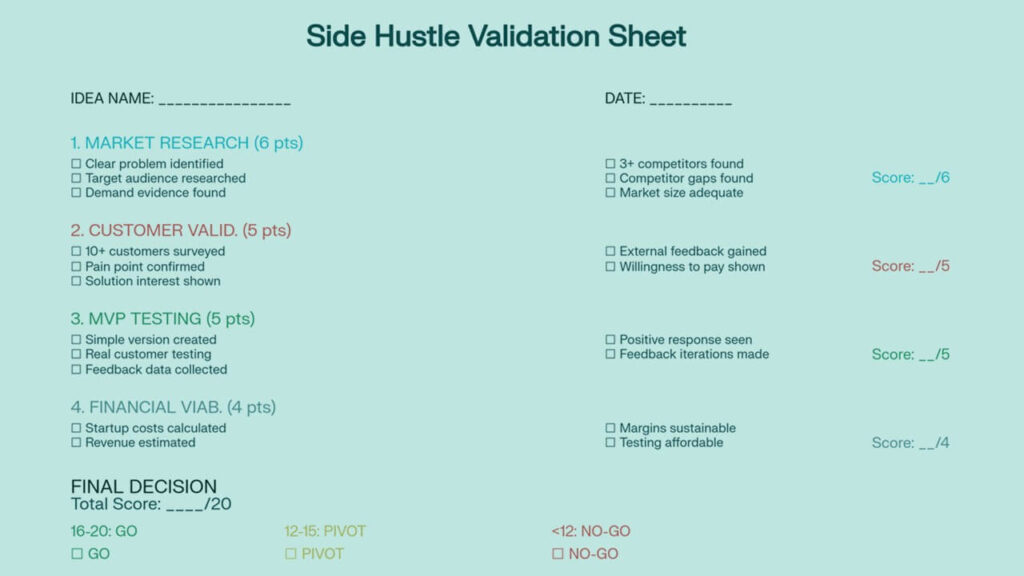
Printable Side Hustle Validation Checklist – A comprehensive worksheet to evaluate your side hustle idea before investing time and money
Audience Feedback and Pre-Selling: Getting Real Market Signals

Beyond Friends and Family: Finding Unbiased Feedback
One of the biggest validation mistakes is relying solely on feedback from friends and family. While their support is valuable emotionally, they’re likely to tell you what you want to hear rather than what you need to know. Their feedback is inherently biased by their relationship with you.
Instead, seek feedback from people who fit your target customer profile but don’t have a personal investment in your success. This might feel uncomfortable initially, but unbiased feedback is infinitely more valuable than polite encouragement from loved ones.
Effective Methods for Gathering Customer Feedback
Surveys and interviews remain the most reliable methods for collecting structured feedback. However, the key is asking the right questions in the right way:
For surveys, focus on behavior rather than opinions. Instead of asking “Would you buy this product?” ask “How do you currently solve this problem?” and “How much do you spend monthly on solutions in this area?”
For interviews, use open-ended questions that encourage storytelling. Ask people to walk you through their current process for handling the problem your side hustle would solve. Listen for frustration points, workarounds, and unmet needs.
Pre-Selling: The Ultimate Validation Test
Pre-selling is perhaps the strongest form of validation because it requires people to put money where their mouth is. This doesn’t mean building a full product first—it means creating a compelling offer and seeing if people are willing to pay for it before you fully develop it.
Effective pre-selling strategies include:
- Landing pages with pre-order options that capture email addresses and payment information
- Crowdfunding campaigns on platforms like Kickstarter or Indiegogo
- Service pre-sales where you book clients before building your full system
- Digital product pre-orders offering early-bird pricing for future delivery
The beauty of pre-selling is that it provides the clearest possible market signal. If people won’t pay for your solution when you’re offering it at a discount with early-bird bonuses, they’re unlikely to pay full price later.
Using Social Media for Validation
Social media platforms offer unprecedented access to your target audience. Use them strategically for validation:
- Post content related to your idea and measure engagement levels
- Run polls asking your audience about their challenges and preferences
- Share behind-the-scenes content about your validation process
- Join relevant groups and participate in discussions naturally
- Use hashtags to reach people interested in your topic
Pay attention to both quantitative metrics (likes, shares, comments) and qualitative feedback (the substance of comments and direct messages). High engagement often indicates genuine interest, while low engagement might suggest limited market appeal.
Building and Testing a Minimum Viable Product (MVP)

Understanding MVPs for Side Hustles
A Minimum Viable Product (MVP) is the simplest version of your offering that can deliver value to early customers while providing feedback for future development. For side hustles, MVPs aren’t about building complex software—they’re about testing your core value proposition with minimal investment.
The goal of an MVP isn’t perfection; it’s validation. You want to test whether your core assumption—that people will pay for your solution to their problem—is correct.
Types of MVPs for Different Side Hustles
Service-Based Side Hustles: Your MVP might be offering your service to a small group of clients manually, even if you plan to automate later. For example, if you’re starting a social media management service, manually manage accounts for 3-5 small businesses before investing in scheduling tools and team members.
Digital Products: Create a basic version of your digital product—perhaps a simple PDF guide instead of a full online course, or a basic app with just core functionality instead of all the bells and whistles you envision.
Physical Products: Consider dropshipping or pre-orders before investing in inventory. Create detailed mockups and product descriptions to test market interest before manufacturing.
Content-Based Hustles: Start with a simple blog or YouTube channel focusing on one specific topic, rather than the comprehensive platform you might eventually build.
Building Your MVP Step-by-Step
Start by identifying your core value proposition—the single most important problem you solve or benefit you provide. Everything else is secondary for your MVP.
- Map out the customer journey from problem awareness to solution implementation
- Identify the minimum features needed to complete this journey successfully
- Choose the simplest tools to build these features (often no-code solutions work perfectly)
- Set a strict timeline (2-4 weeks maximum) to prevent over-engineering
- Launch to a small group of early testers rather than the general public
Testing Your MVP Effectively
Successful MVP testing focuses on user behavior rather than user opinions. Track what people actually do, not just what they say they’ll do:
- Usage metrics: How often do people use your MVP? How long do they engage?
- Completion rates: Do users complete the intended actions or drop off partway?
- Return behavior: Do people come back after their first experience?
- Referral patterns: Do users recommend your MVP to others?
- Payment behavior: For paid MVPs, do people actually complete purchases?
Combine quantitative data with qualitative feedback through follow-up interviews with MVP users. Ask specific questions about their experience, what value they received, and what would make them more likely to use or recommend your solution.
Pilot Projects and Trial Runs: Real-World Testing

The Power of Pilot Testing
Pilot projects allow you to test your side hustle in real-world conditions with actual customers, providing insights that surveys and MVPs can’t match. Unlike theoretical validation, pilot projects reveal operational challenges, customer service needs, and scalability issues before you fully commit.
A well-designed pilot project minimizes your risk while maximizing learning opportunities. It’s better to run a small pilot that teaches you valuable lessons than to launch broadly and fail expensively.
Designing Effective Pilot Projects
Start small but think systematically about what you want to learn. Your pilot should test specific hypotheses about your business model:
- Can you deliver quality results consistently?
- How long does delivery actually take versus your estimates?
- What customer service issues arise that you hadn’t anticipated?
- Are your pricing assumptions realistic given actual costs and time investment?
- Do customers get the value you expect them to receive?
For service-based side hustles, consider offering your service free or at a steep discount to 5-10 ideal customers in exchange for detailed feedback and testimonials. For product-based businesses, test with a small batch of products sold to a limited customer segment.
Collecting and Acting on Pilot Feedback
Structure your pilot to capture both quantitative results and qualitative insights. Create systems to track:
- Delivery metrics: Time to complete, error rates, customer satisfaction scores
- Financial data: Actual costs versus projections, time investment per customer
- Customer feedback: Detailed interviews or surveys about their experience
- Operational challenges: What went wrong and how you solved it
- Scalability insights: What would need to change to serve 10x more customers
The most valuable pilot feedback often comes from unexpected challenges. Document everything, even problems that seem minor—they often become major issues at scale.
Measuring Results and Identifying “Green Flags”

Key Metrics That Matter
Not all validation signals are created equal. Focus on metrics that directly indicate market demand and business viability:
Engagement Metrics: For digital products or content, track time spent, pages viewed, and return visits. High engagement suggests genuine interest rather than casual curiosity.
Conversion Metrics: The percentage of people who take your desired action—signing up for updates, requesting information, or making purchases. Even small conversion rates can indicate market interest if the absolute numbers are meaningful.
Willingness to Pay: The strongest validation signal is when people actually pay money for your solution, even in a pre-sale or pilot format.
Word-of-Mouth Referrals: When customers voluntarily recommend your solution to others, it indicates strong satisfaction and market fit.
Green Flags: Signs Your Idea Has Potential
Look for these positive indicators during your validation process:
- Customers volunteer specific ways they’d use your solution rather than giving generic positive feedback
- People ask when they can buy or how to get access to your full solution
- You receive unsolicited inquiries from potential customers who heard about your idea
- Competitors reach out asking about partnership or acquisition opportunities
- Early customers become repeat users and provide detailed testimonials
- You identify adjacent market opportunities that could expand your business
Red Flags: Warning Signs to Heed
Equally important are the warning signs that suggest you should pivot or stop:
- Consistently low engagement across all your validation efforts
- Customers express interest but won’t commit time or money when asked
- You’re the only person excited about solving this particular problem
- Market research reveals shrinking demand or well-funded competitors with similar solutions
- Customer feedback focuses on features rather than the core problem you’re solving
- You find yourself having to convince people they have the problem you’re solving
When to Pivot vs. When to Persist
Validation isn’t always binary—sometimes the signal is to modify your approach rather than abandon it entirely. Consider pivoting when:
- The core problem is real but your solution isn’t resonating
- You’ve identified a related problem that generates more customer interest
- Different customer segments show more enthusiasm than your original target
- Your solution works but the business model needs adjustment
Persistence makes sense when you’re seeing consistent positive signals but need to refine execution. Pivoting is wise when fundamental assumptions about your market or solution prove incorrect.
Common Validation Mistakes to Avoid

Relying Too Heavily on Opinions vs. Behavior
One of the most dangerous validation mistakes is treating opinions as facts. People often say they’d buy something they’d never actually purchase, or express enthusiasm for ideas they’d never prioritize in real life.
Focus validation efforts on observing and measuring behavior rather than collecting opinions. What people do reveals their true priorities and willingness to pay better than what they say they’d do.
Overcomplicating Your MVP
Many entrepreneurs sabotage their validation by trying to build too much too soon. They convince themselves they need more features, better design, or more sophisticated technology before they can test their idea properly.
Remember: the purpose of validation is learning, not launching. A simple MVP that provides 80% of the value with 20% of the features often teaches you everything you need to know.
Ignoring Negative Signals
Confirmation bias leads many entrepreneurs to dismiss negative feedback or rationalize poor validation results. They explain away low engagement, justify why people aren’t buying, or convince themselves they just need to find the “right” customers.
Negative signals are data, not personal attacks. Treat them as valuable information that can save you from bigger mistakes later. Sometimes the best business decision is choosing not to pursue an idea that isn’t resonating with the market.
Giving Up Too Early
Conversely, some entrepreneurs abandon promising ideas after the first signs of difficulty. Validation isn’t always smooth or immediate—sometimes good ideas need refinement or different positioning to find their market.
The key is distinguishing between ideas that need iteration and ideas that lack fundamental market demand. If you’re getting consistent interest but struggling with execution, keep iterating. If you’re getting consistent indifference despite multiple approaches, consider pivoting.
Validating with the Wrong Audience
Testing your idea with people who aren’t actually potential customers provides misleading data. This often happens when entrepreneurs survey friends and family or test in convenient but irrelevant communities.
Ensure your validation audience matches your target customer profile as closely as possible. If you’re building a solution for small business owners, validate with small business owners, not college students or retirees (unless they’re also small business owners).
Your Step-by-Step Validation Action Plan

Week 1: Market Research and Competitive Analysis
Start with broad market research to understand the landscape:
- Spend 2-3 hours researching your market using Google, industry reports, and trend data
- Identify 5-10 direct and indirect competitors
- Join 3-5 online communities where your target customers gather
- Document 10-15 specific customer pain points you discover
- Create a simple competitive analysis comparing features, pricing, and customer feedback
Week 2: Customer Discovery and Interviews
Focus on understanding your potential customers deeply:
- Recruit 10-15 people who fit your target customer profile for brief interviews
- Conduct 20-30 minute conversations asking about their current challenges and solutions
- Survey additional potential customers using online tools if needed
- Analyze patterns in the feedback you receive
- Refine your understanding of the problem you’re solving
Week 3: MVP Development and Testing
Build and test your minimum viable solution:
- Create the simplest possible version of your solution
- Test it with 5-10 people from your customer interview group
- Collect usage data and user feedback systematically
- Iterate based on what you learn
- Document what works and what doesn’t
Week 4: Results Analysis and Decision Making
Synthesize your learning and make your go/no-go decision:
- Compile all your validation data into your decision framework
- Calculate your validation score using the provided checklist
- Identify the strongest signals (both positive and negative)
- Make your decision: Go, Pivot, or No-Go
- If Go: plan your next steps for launch or further development
- If Pivot: determine what changes to test next
- If No-Go: celebrate the money and time you saved by validating first
Tools and Resources for Validation

Free Market Research Tools
Google Trends helps you understand search volume and interest over time for keywords related to your idea.
Answer the Public reveals the questions people ask about topics related to your side hustle.
Reddit and Facebook Groups provide direct access to customer conversations and pain points.
Your Local Library often provides free access to industry reports and market research databases.
Survey and Feedback Tools
Google Forms offers basic survey functionality at no cost.
SurveyMonkey provides more advanced features and analytics.
Typeform creates more engaging, conversational surveys.
User Interviews can help you find and recruit interview participants.
MVP Building Tools
Landing Page Builders like Carrd, Unbounce, or WordPress help you create simple test pages.
No-Code Tools like Bubble, Webflow, or Zapier let you build functional prototypes without programming.
E-commerce Platforms like Shopify or Gumroad allow you to test product sales quickly.
Analytics and Tracking
Google Analytics tracks website visitor behavior and engagement.
Hotjar provides heat maps and user recordings to understand how people interact with your MVP.
Social Media Analytics help you measure engagement and reach across platforms.
Taking Action: Your Validation Starts Now
Validating your side hustle idea isn’t just smart business practice—it’s the difference between building something people want and wasting months on something nobody needs. The entrepreneurs who succeed aren’t necessarily those with the best initial ideas, but those who validate and iterate most effectively.
Remember, validation isn’t about seeking permission or waiting for guaranteed success. It’s about gathering enough evidence to make informed decisions about where to invest your time and energy. Even if your current idea doesn’t validate well, the skills you develop and insights you gather will serve you in finding and validating your next opportunity.
The validation process outlined in this guide has helped thousands of entrepreneurs save time, money, and frustration while building sustainable side hustles. Some discovered their ideas needed pivoting, others found unexpected market opportunities, and many gained the confidence to move forward with ideas that might have remained “someday” dreams.
Your validation journey starts with a single action. Choose one validation method from this guide—perhaps spending an hour researching your competition or reaching out to potential customers for brief interviews. That first step often reveals insights that reshape your entire approach and dramatically improve your chances of success.
Don’t wait for the perfect moment or the perfect idea. Start validating today, and transform your side hustle dreams into data-driven reality. Your future customers—and your bank account—will thank you for taking the time to get it right from the beginning.
This article is part of our series, “Choosing the Right Side Hustle for You: The Complete Beginner’s Guide” For a deeper dive into selecting, validating, and launching your ideal side hustle, explore the full guide.